
Retiree Kristina Is Approaching 85 – Help Exists on Paper, Not in Reality
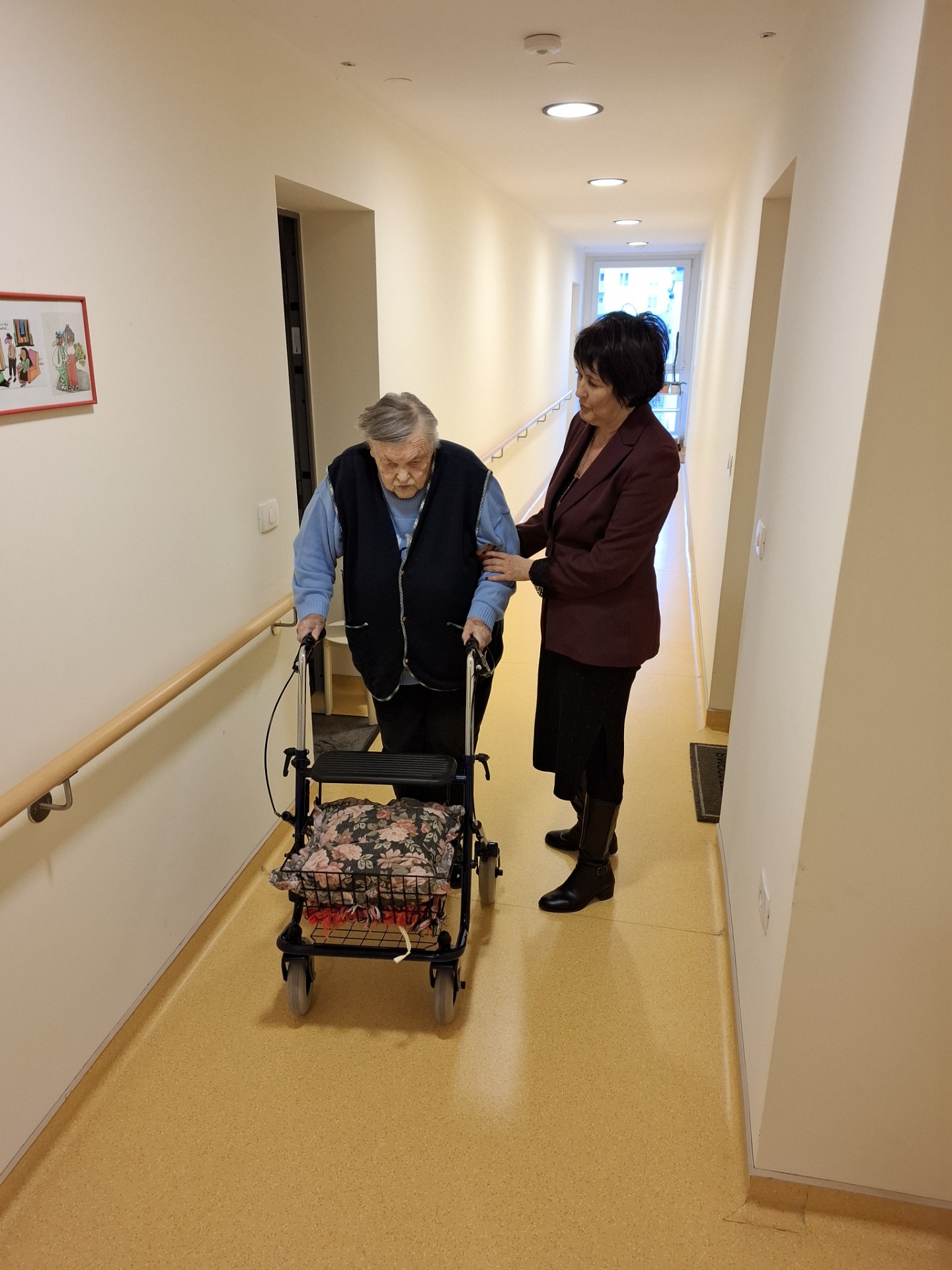
Kristina, a retiree, she is nearing her 85th birthday. She considers herself an active older woman, yet openly admits that the ailments of old age have begun to take their toll. She would already need some assistance with more demanding daily tasks, which is why she applied for home care. She applied six months ago.
“A pile of paperwork,” she sums up briefly, “but no help – no response.”
She is left to fend for herself. Thanks to the commendable kindness of good neighbours, life is somewhat easier. But, as she stresses, help is something she also pays for.
Offered Cash for 20 hours Instead of 80 hours of Care
Vili, 87, lives alone. He is cared for by his daughter; if she is absent or falls ill, he is left entirely on his own. He has difficulty walking and falls frequently. He needs help with washing, dressing, and using incontinence aids. He is also completely dependent on others for everyday tasks such as shopping, cleaning, managing finances, and preparing a hot meal. He is forgetful and often fails to take his medication.
Because he does not wish to move into a residential care home, he applied for home care in June.
He has been placed in Category 4, which entitles him to 80 hours of care per month. Yet he is still waiting. As officials told his daughter, there is no suitable staff available. The amount of money offered to him instead of services would cover only 20 hours of care if purchased from a private provider or on the grey market.
After Paying for Care, Not Even Enough for a Cup of Coffee
The mother of Renata Jenko is 90 years old. As a tenant, she lives in sheltered housing in Koper. Renata has already arranged an individual home-care plan for her mother within the long-term care system. In practice, she admits, the system does not work.
“The fact is that in Koper, long-term home care does not function and won’t for several more months because there is no staff.” Instead of services, her mother was offered a cash benefit of €352. As Renata explains, this amount “does not cover the cost of home care, which for 2.5 hours per day comes to around €480 per month.”
Despite promises of lower bills, her mother cannot afford to move into a care home. Renata would have to make up the difference. “And yet the state claims that children will no longer have to pay extra for their parents.”
Renata’s mother was never employed; she was insured through her husband and, after his death, received his pension. She now receives €504 plus a care allowance of just under €200. This is not enough to cover her monthly expenses.
In a sense, she is fortunate to live in sheltered housing in Koper, where the municipality subsidises her rent and also covers the cost of lunch.
She pays €80 for the apartment and €480 for home care. The rest goes toward utility bills, electricity, phone services, and building management fees. What little remains is not enough for groceries, hygiene products, or medications she must pay for herself. Her daughter Renata helps her. Renata is a teacher and herself approaching retirement this year. She fears for her own future.
“On paper, the idea looks good,” she says thoughtfully, “but in reality, I don’t think it will be sustainable in the long run.”
At Least Another Six Months Without Rights
Renata’s mother falls into Category 4, meaning she is entitled to 80 hours of care per month – less than three hours a day.
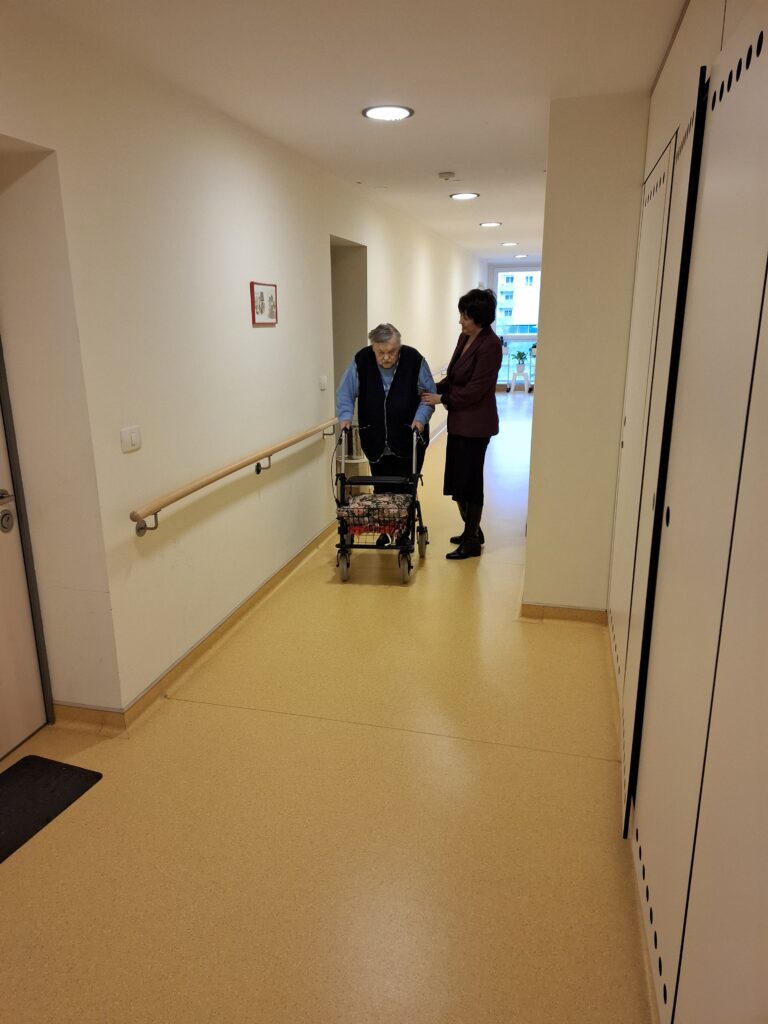
“She is still mobile enough to go to the toilet with a walker. At night she wears a diaper, and she needs help with daily tasks, dressing, washing, and personal hygiene.”
Renata has been told that her mother will not receive free home care for at least another six months – again, due to staff shortages. She can receive a cash benefit of €354 instead, but this would mean losing the care and assistance allowance worth €170.
If she were to receive home care as provided for by law under long-term care, Renata’s calculations show that a much larger portion of her mother’s pension would remain for food and medical supplies.
“She could afford a coffee, fruit, and an occasional treat. We wouldn’t have to look for help on the black market or from private providers. But if you’re an ordinary citizen, you don’t get this help – even if your health condition entitles you to it. Simply because there aren’t enough workers, no suitable staff.”
Municipal Subsidies for a Dignified Old Age
The Municipality of Koper ranks seventh among Slovenian municipalities by surface area. It is among the more densely populated municipalities and includes a large rural hinterland. According to statistical data, the average age of residents is above the national average (Koper: 44.6 years; Slovenia: 44.1 years). For every 100 residents aged 0–14, there are 156 residents aged 65 or over, giving the municipality a higher ageing index than the national average.
Koper is one of the few municipalities that took care of its elderly residents even before the state did. Last year, it allocated over one million euros for social care of older people and also provides financial assistance for heating, food, hygiene, utility bills, medications, and assistive devices. For elderly and disabled residents, this assistance is increased by an additional 15%.
The municipality implements and co-finances home care and contributes to institutional care for more than 150 users.
The director of the Obalni dom Koper, Neva Tomažič, MSc, explains that there are currently 210 people on the waiting list for home care in the municipalities of Koper and Ankaran, while 188 people are already receiving the service. Care is currently provided by 33 employees.
“We, too, are facing a staffing crisis, resulting from the demanding nature of the work, heavy workloads, and a general shortage of staff in social care. This is directly reflected in waiting times and limited opportunities to expand the service.”
Delaying Care Is a Death Sentence for the Elderly
These are the stories of individuals who trusted the state. A fundamental right – home care that would allow people to remain in their own homes longer – is still not truly alive six months after the law came into force, as social care providers warn. Some projections suggest that access to these rights could be delayed by one to two years.
What does this mean for all those elderly people who have been paying for care since last summer and need it immediately?
“All the anomalies of this system are coming to the surface. On the ground, we are increasingly confronted with people demanding concrete answers: why we cannot actually provide long-term home care in the scope stated in their official decisions. Almost none of the users on waiting lists – across different categories – want cash benefits. They want the hours they are entitled to. They want a person to come into their home and provide care, not money and the burden of figuring everything out on their own,” report service providers across the country.
What Does 110 Hours per Month in Category 5 Really Mean?
Under the new system, beneficiaries in the most severe Category 5 are entitled to 110 hours of care per month, while those in Category 4 are entitled to 80 hours. Category 1 and 2 users receive 20 and 40 hours per month, respectively.
For Category 5 users, this means either:
- 5.5 hours per day from Monday to Friday, or
- 3.5 hours per day from Monday to Sunday.
Slicing Care Into Minutes Dehumanises
Care workers are scheduled down to the minute. Martin Kopatin, director of the Pristan Institute, publicly warns that while minutes may look sensible on paper, in reality they create absurd pressure on employees.
For example, caregivers sometimes have only two minutes allocated for hydrating an elderly person – and one does not need basic chemistry knowledge to calculate how long it takes water to boil. Conditions in the field are often even worse. Many elderly people live in cold homes. During bathing, the caregiver must ensure warm surroundings and warm water – all of which falls on their shoulders.
Providers warn that breaking care down into minutes means taking away rights elsewhere. If a user needs more time for bathing, it may mean fewer minutes for drinking or other basic assistance.
“People are not machines, and care is not an industrial process. Focusing on norms and minutes leads, in our view, to a loss of humanity and dignity, which is why such an approach is unacceptable,” said Valerija Lekić Poljšak, president of the assembly of the Association of Social Care Institutions, calling for unresolved issues in long-term care to be addressed.
Small Change in Exchange for Care
The situation is even worse where services cannot be fully provided at all due to lack of staff. In such cases, users are offered financial compensation instead. This is where the system breaks down at its core.
Providers explain plainly: “If a user is entitled to 110 hours of long-term care per month, that means around 3.5 hours of care per day, seven days a week. These are people who truly need several hours of help daily. At the same time, care is rarely delivered in one continuous block. Users often need help in the morning, at noon, and in the evening – fragmented visits that are almost impossible to manage logistically and in terms of staffing.”
They add: “To truly provide 110 hours per month to one user, you practically need one caregiver per user, accounting for holidays, sick leave, and working time limits. The system collapses before it even starts – unless the state were to import large numbers of workers, which is not a realistic plan.”
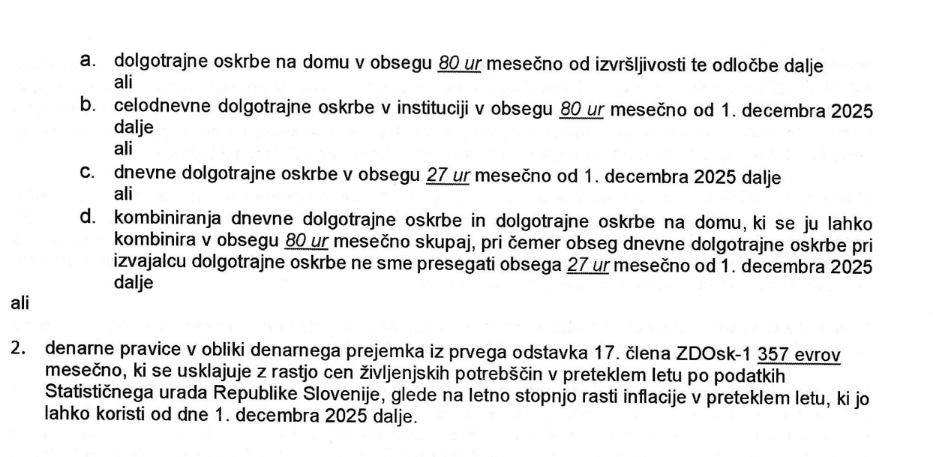
Despite having a legal right to 110 hours of service, users are instead offered €491 in cash. Tatjana Milavec from the Association of Social Work Centres also stresses that this cash benefit is low and disproportionate to the actual cost of care.
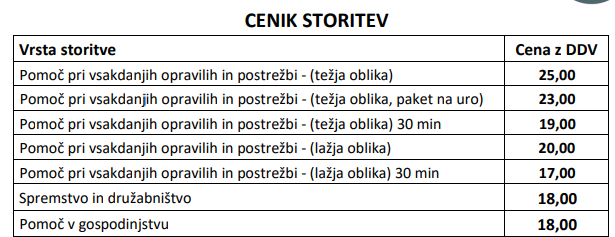
On the open market, users face a shock. Price lists show that for intensive care in Category 5, the hourly rate is around €25. With €491, a user cannot afford even 20 hours of care per month, let alone the legally prescribed 110 hours.
“How Long Will They Keep Stringing People Along?”
This is one of the key anomalies of long-term care: official decisions promise a scope of rights the system cannot deliver, and then offer an amount of money that cannot even cover a fifth of the entitled services.
Who will ultimately be held accountable for the gap between written rights and actual delivery?
“It is clear that the state will not be able to provide home care in the scope stated in the decisions, because that would entail real labour costs. Caregivers would need to be paid significantly more than they are now; we will not attract new staff for minimum wages. How did they imagine they could keep stringing people along like this, with decisions in hand?”
For a social care institution, the cost of one caregiver is at least €1,800 gross per month. The user, meanwhile, is offered €491. The question remains: where does the rest of the money go, and who is it really intended for?
The Elderly Do Not Want Money – They Want Care
“My direct experience from the field shows that users and their families mostly do not want money; they want real services in their homes. When we explain that providing 110 hours is practically impossible, they often ask whether a combination is possible – for example, 50 hours of home care (which we often cannot even provide) and the rest in cash. The law does not allow this combination. Personally, I find this extremely problematic, because in practice it means that part of the funds will simply remain in the state coffers, while users are left without services.”
Ministry Shifts Firefighting to Providers
The Ministry for a Solidary Future has not responded to questions about how it intends to address these gaps between allocated and actual rights – nor to a range of other questions – since December 15 of last year.
Key dilemmas of the reform are being postponed into the so-called transitional period until September 30, 2026. Until then, the system will operate in a hybrid mode: formally new, but substantively riddled with unanswered questions. The burden of confusion, user communication, and emergency staffing measures will fall on long-term care coordinators, nursing homes, and service providers on the ground.
Long-term care remains a right on paper – not help a person receives when they truly need it.
SUPPORT US, SUPPORT INDEPENDENT JOURNALISM
Why support us?
Because we are independent of political interests and powerful financial elites. Because people and their rights matter most to us.
In a world where the voices of the vulnerable are too often silenced, and where financial and political pressures frequently prevent important information from reaching the public, investigative journalism remains one of the last safeguards of truth and justice.
Journalism in Slovenia is increasingly constrained by business and political interests. Media outlets are often used to discredit individuals and to settle political scores rather than to serve the public interest.
Your support means more than a donation—it means that you believe in a world where injustices can be corrected. It means that you believe in a world where wealth and influence cannot be used to suppress the publication of important information. Most importantly, it means that you believe in us: that we have the courage to publish everything we determine to be in the public interest.
Your donation enables us to investigate wrongdoing, uncover hidden stories, and protect those who have no voice. It helps us fight corruption, disinformation, and injustice.
Institute for Investigative Journalism and Research
Nanoška 3
1000 Ljubljana, Slovenia
Nova Ljubljanska banka (NLB)
Account Number (IBAN):
SI56 0284 3026 6324 932
Donation

Thank you,
Barbara and Nataša
Preiskovalno.si is an independent media outlet.


