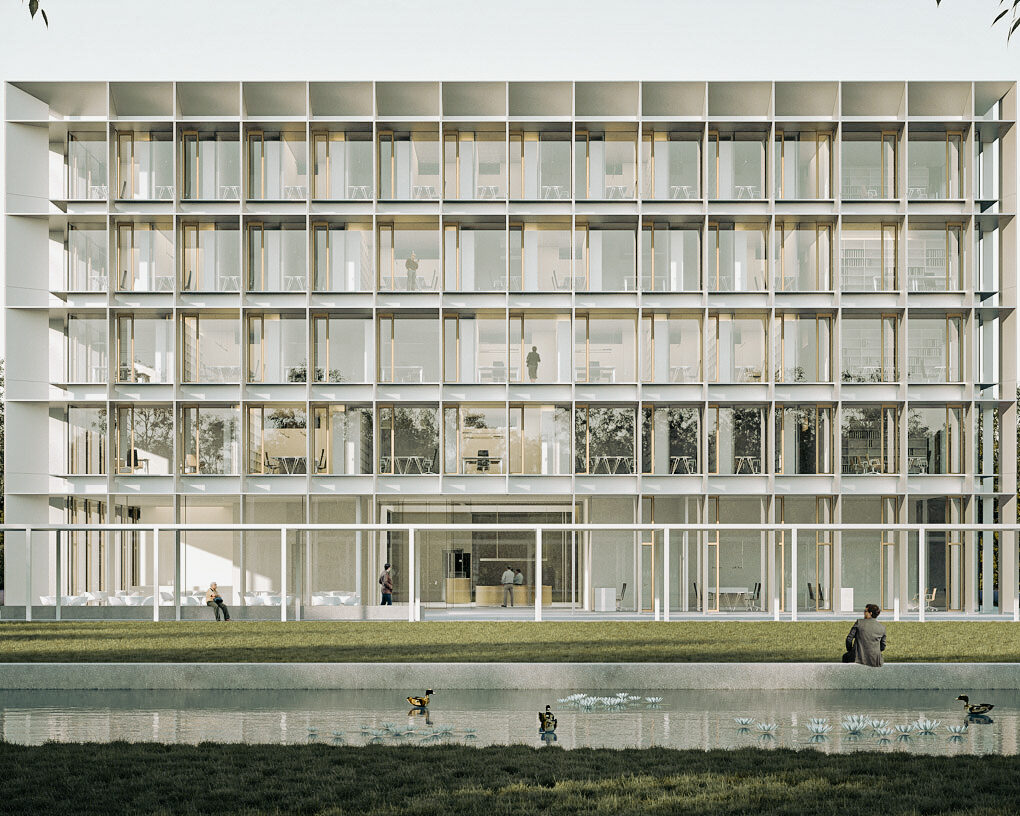
The foundation stone for the DARS office building in the Grič area of Ljubljana was laid in September 2021.
The site is located on the grounds of the former SCT brickworks, where industrial waste could reasonably have been expected in the soil due to the activities of Ivan Zidar’s construction company.
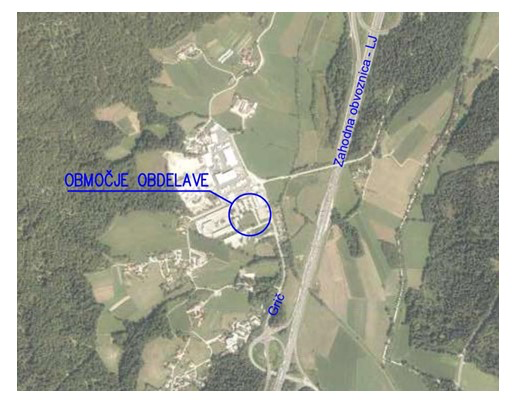
However, investigations into the contamination of the excavated soil were not included in the project plans at all.
Our investigation found significant methodological shortcomings and delays in the site surveys, which later led to the accidental discovery of hazardous waste and dramatic cost overruns.
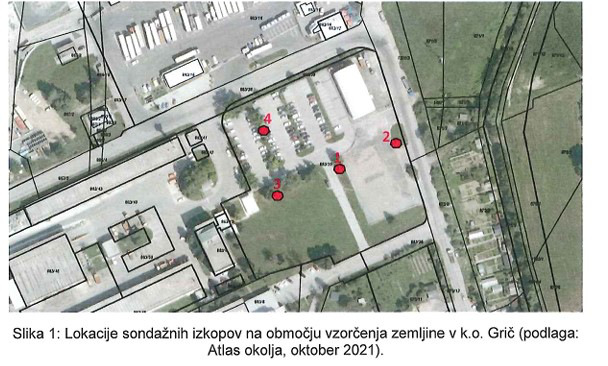
During the initial analysis, only four exploratory test pits were dug, and even those reached a maximum depth of just 2.5 meters.
Only the Reusability of the Soil Was Examined
In October 2021, the company Eurofins ERICO from Velenje carried out soil sampling at the construction site.
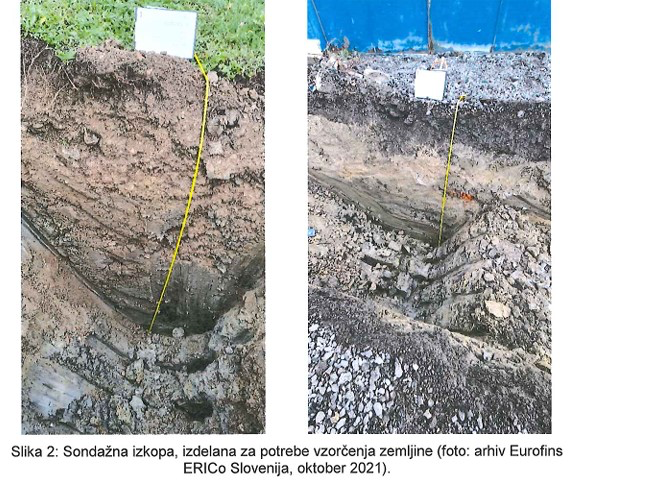
The analyses revealed the presence of heavy metals, PAHs, PCBs, and other hazardous substances, but the laboratory did not detect concentrations exceeding regulatory limits.
ERICO measured a mineral oil content of 90 mg/kg of dry matter, which was just below the then-applicable limit value of 100 mg/kg. The soil contained only 10 milligrams less toxic material than the critical threshold.
Based on these findings, ERICO issued a positive opinion stating that the soil was not hazardous and was suitable for reuse, meaning it could be used on construction land.
The entire volume of material was classified as “clean” based on a single composite representative sample made up of 32 subsamples. Such a method can potentially conceal the true concentration of contamination.
They Were Not Investigating Hazardous Waste
As DARS explained to Preiskovalno, the analysis was not intended to determine whether the area was contaminated with hazardous waste. Instead, it was conducted solely to assess whether the excavated material was suitable for reuse.
The purpose of the investigation was therefore limited to determining whether the material could be reused for embankments and filling works.
Because the sampling was limited, the laboratory failed to detect the more serious contamination that became evident only during deeper excavations conducted later.
Oily Stains, Foul Odors, and Carcinogenic Soil
The main contractor, CGP, began excavating the construction pit for the office building the very next month after the survey.
During these works, workers immediately noticed visible signs of contamination.
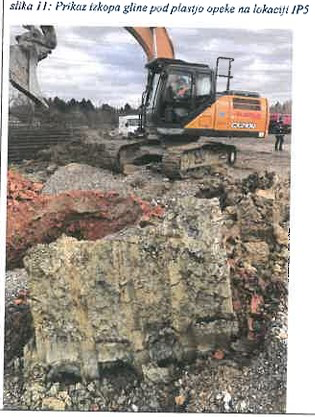
According to the Technological Report for the Removal of Hazardous Soil, the excavation encountered an artificial fill layer containing pieces of brick. At the same time, a strong hydrocarbon odor was detected. An oily film or stain was also visible on the surface of water that had accumulated in the excavation pit.
The discovery was officially documented in the construction logbook.
Due to suspicions of hazardous waste, additional sampling was ordered. The company Ikema collected soil samples at five locations at depths of 2 and 4 meters.
The purpose was to determine whether contamination from the upper layers of artificial fill and brick debris had penetrated into the underlying clay layers.
Laboratory analyses conducted by Ikema company painted a significantly different picture from the earlier, shallower sampling.
At greater depths, they detected and confirmed contamination by a broad range of hydrocarbons in the C10–C40 range, at concentrations far exceeding those previously identified.
IKEMA found extensive contamination. Laboratory results confirmed that mineral oil concentrations exceeded the permitted threshold for hazardous soil characteristics by more than 31 times.
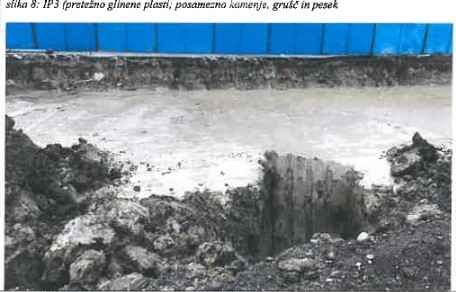
At a depth of 4 meters, mineral oil concentrations reached 3,130 mg/kg, while the maximum permitted value was only 100 mg/kg.
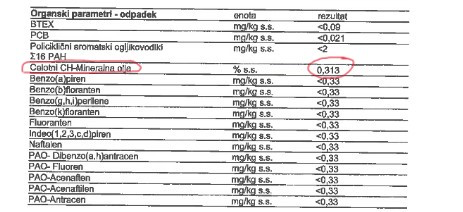
Ikema confirmed contamination by petroleum-derived substances.
According to European Commission regulations, carcinogenic waste classified as HP7 “causes cancer or increases its incidence,” while waste classified as HP14 possesses ecotoxic properties and “presents or may present immediate or delayed risks to one or more sectors of the environment.”
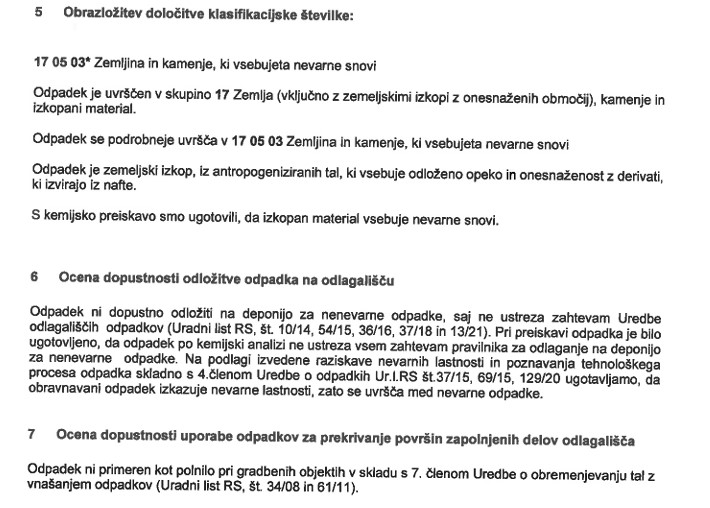
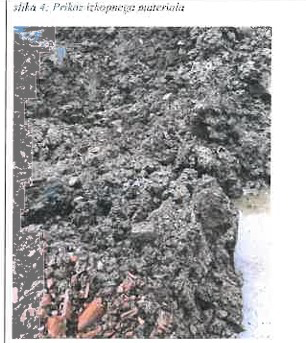
Carcinogenic Waste Sent to Austria?
The hazardous waste was collected and transported by the company Saubermacher from Lenart.
Two self-employed drivers working as subcontractors for Saubermacher transported hazardous waste from the DARS construction site. Although they declined to speak publicly, they told Preiskovalno.si that they delivered the hazardous material to Kidričevo, where Saubermacher operates a modern hazardous-waste treatment facility.
According to the plan, the hazardous waste was then supposed to be transported to Austria for further treatment.
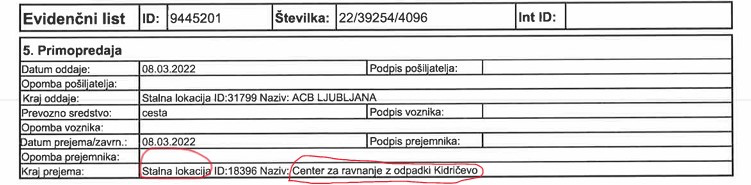
When asked to provide invoices proving that the hazardous waste had been delivered to Austria, the company responded:
“All waste was transported to Kidričevo, where temporary storage was organized in accordance with the relevant permits. After the temporary storage phase was completed, the waste was sent to a specialized treatment center in Austria, where final processing was carried out. We would also like to clarify that Saubermacher Slovenija did not have a direct contractual relationship with DARS on this project but participated as a subcontractor to another contractor. As a private company, we do not disclose details of contractual relationships and business agreements with clients.”
We also contacted CGP, the main contractor, which had nominated Saubermacher for the transportation of hazardous waste.
CGP replied:
“Waste management was carried out in accordance with applicable regulations through entities possessing the necessary permits and authorizations. For more detailed information regarding waste classification, laboratory analyses, the exact composition of the waste, subsequent treatment, temporary storage, and any transport abroad, we suggest contacting Saubermacher directly, as the authorized recipient of the hazardous waste.”
Documents Paint a Different Picture
Particularly unusual is CGP’s wording regarding “possible” transport abroad.
The Technological Report for the Removal of Hazardous Waste explicitly mentions Lannach, Austria, as the final destination. DARS has stated the same.
However, all waste-tracking records identify the Waste Management Center in Kidričevo as both the final receiving location and the permanent location of the hazardous waste.
Furthermore, official records show that some waste-tracking forms list the intended treatment method as physico-chemical treatment under procedures D9 and D13.
Such official records could indicate that the final treatment of the waste was actually carried out in Slovenia.
If the material had merely been waiting in Kidričevo for transport to Austria, the appropriate designation would have been D15, which refers to temporary storage.
Apparent Inconsistencies
The hazardous waste discovered at the DARS office building site raises serious questions about traceability.
Every recipient of waste is required to record its movement on a waste tracking form. These forms are therefore the official documents used to monitor waste management and ensure traceability from beginning to end. They are the only legally recognized means of tracking waste in the Republic of Slovenia.
In this case, the statements made by all parties involved appear to be inconsistent with the legally binding documents that have been presented.
Waste tracking forms entered into the official state system, IS ODPADKI (eng: IS WASTE) , are finalized records and may not be altered or corrected afterward. We observed a similar anomaly during our investigation of Dosje Dobrunje, where criminal complaints were filed precisely because of manipulated waste-tracking forms.
The finalized forms in the Saubermacher case do not mention any temporary storage of hazardous waste.
If the hazardous waste had indeed been only “temporarily stored” in Kidričevo, new tracking forms should exist documenting its transport from Kidričevo to Austria.
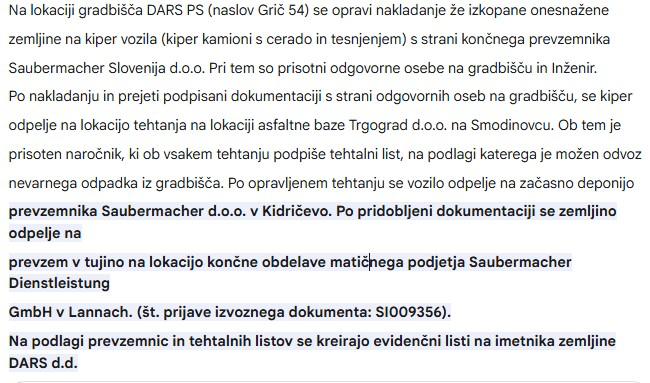
Saubermacher, however, emphasized that:
“For cross-border waste shipments, waste tracking forms are not issued; transport documents are used instead. Therefore, the absence of waste tracking forms does not constitute an irregularity.”
The company further explained that a certificate releasing the bank guarantee is an official document proving that the waste was properly and legally transported to Austria in accordance with all required permits.
When asked whether the waste had been properly transferred and treated and what evidence existed to support this, DARS responded:
“The transfer of hazardous waste is documented by waste tracking forms identifying Saubermacher as the authorized recipient. According to the accompanying documentation, the waste was weighed and pre-treated before being transported for further treatment. Documentation regarding subsequent treatment is maintained by the authorized recipient.”
We should also recall our findings in Dosje Dobrunje, where the Environmental Inspectorate filed criminal charges against Saubermacher over alleged irregularities in the remediation of hazardous waste.
A Call from Saubermacher
This morning, representatives of Saubermacher contacted us after seeing an announcement about the continuation of our investigation into the DARS building and informed us that they would provide the requested documents.
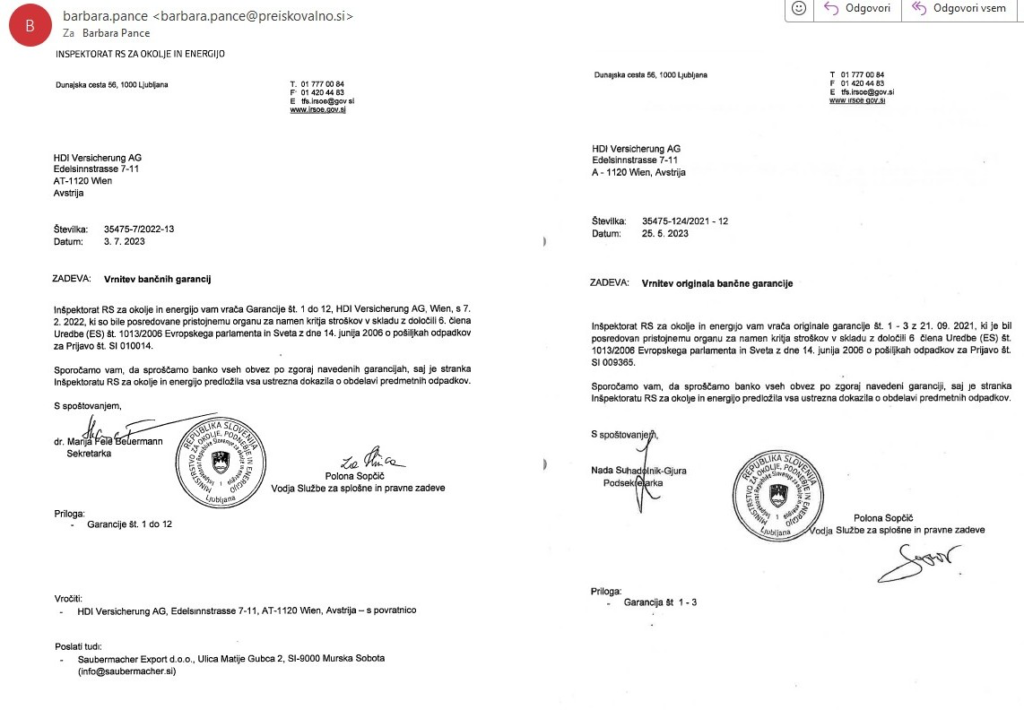
Less than an hour before publication, they sent us a statement describing the handling of the hazardous waste along with a certificate confirming the release of the bank guarantee:
“Between 8 March 2022 and 30 June 2022, Saubermacher Slovenija d.o.o. accepted 1,138,600 kilograms of waste classified under code 17 05 03* at the DARS location, ACB Ljubljana, Grič 54, Ljubljana.
All waste shipments were properly weighed on a calibrated scale and subsequently transported to Saubermacher Slovenija d.o.o., Tovarniška cesta 10, Kidričevo, to our Hazardous Waste Management Center.
At this facility, 688,440 kilograms of waste were treated. The treatment process produced waste classified under code 19 03 04*. This resulting waste was transported to Austria for final treatment under valid cross-border waste shipment authorization No. 35475-124/2021-9 (Notification SI009365).
The remaining 450,160 kilograms of waste classified under code 17 05 03* were likewise transported to Austria under cross-border shipment authorization No. 35475-7/2022-8 (Notification SI010014).”
Although these documents confirm that Saubermacher submitted paperwork for the export of specific quantities of waste under the referenced notification numbers, the discrepancy with the waste tracking forms remains unresolved.
As a result, the traceability of the waste has still not been conclusively demonstrated.
Manipulation of Public Funds
The quantity of hazardous waste amounted to approximately 55 truckloads, or 1,098 tonnes, assuming an average truck capacity of 12 cubic meters.
The discovery of hazardous waste was used as the primary justification for substantial cost increases in the project, which became more than €5 million more expensive through Addendum No. 1.
On 21 October 2024, DARS Management Board Chairman Andrej Ribič explained the increase to the media outlet 24ur:
“The addendum was signed because we discovered that the soil was heavily contaminated. We had to transport it to Austria.”
Through Addendum No. 1, Saubermacher entered the project as a subcontractor.
The planned value of the work for the “transport and acceptance of hazardous waste” amounted to €603,600 excluding VAT (€736,400 including VAT).
We attempted to obtain information about hazardous-waste treatment prices and how such treatment is organized in Austria. However, companies do not publish price lists for the treatment of carcinogenic and ecotoxic waste.
Based on the amount paid, the cost of collection and treatment may have been approximately €550 per tonne.
Whether this price differs from normal market rates remains unclear, as hazardous-waste treatment is reportedly priced individually according to the composition of the waste and the treatment method required.
We continue to seek answers and supporting evidence from those responsible.
Misleading Claims About Hazardous Waste?
The cost of transporting hazardous waste represented only about one-tenth of the total value of Addendum No. 1, which increased project costs by €5.2 million.
Most of the additional money was spent on other work rather than on hazardous waste management.
This may indicate that Austria was used as a convenient explanation for justifying other substantial costs that arose due to professional shortcomings in the project.
Even before the first addendum was signed, a total of 61 claims for additional work had already been submitted, suggesting that new requirements and project deficiencies emerged immediately after construction began.
Contaminated Bricks Treated as Non-Hazardous Waste
During excavation for the DARS office building, workers also encountered what was described as “oily brick material.”
However, the contaminated bricks themselves were never analyzed.
Only samples of the clay beneath the brick layers were subjected to laboratory testing.
In its report, IKEMA explicitly stated:
“Sampling of the clay does not represent the entire soil profile across the site but only the condition of the clay beneath the artificial fill, brick layers, and hydrocarbon-contaminated brick layers.”
This means that despite visible oil stains and a strong smell of hydrocarbons or petroleum, the bricks themselves were never tested for hazardous properties.
Nevertheless, the bricks were ultimately classified as completely clean and non-hazardous.
The Technological Report clearly required visibly contaminated bricks to be separated for later analysis:
“If visual inspection indicates that the brick material is contaminated, it shall be separated at the construction-site stockpile for subsequent analysis and further disposal procedures.”
Despite this requirement, no such analyses were carried out.
At the same time, Ikema had already confirmed in laboratory testing that the clay beneath the bricks contained carcinogenic and ecotoxic substances at concentrations exceeding the permissible limit by 31 times.
Moreover, mineral oils had clearly seeped through the bricks into the lower clay layers, causing contamination.
Yet nearly 4,000 tonnes of brick material were treated as non-hazardous waste.
Violation of Their Own Procedures and Protocols
The documents we reviewed contain detailed descriptions of the bricks and multiple indications of contamination. Photographs show contamination by mineral oils.
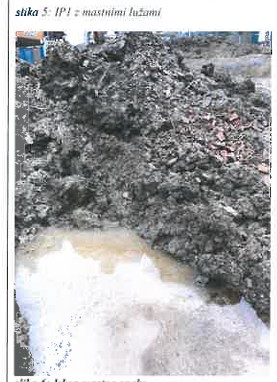
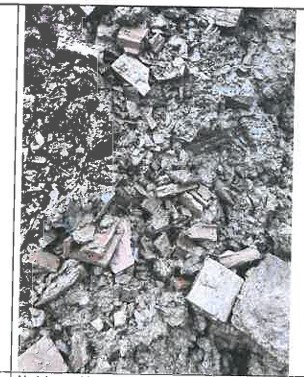
Nevertheless, the required analyses were never performed.
From a physical standpoint, it is difficult to imagine that bricks through which carcinogenic and ecotoxic oils had seeped could themselves be entirely uncontaminated.
The final Waste Report even states that all of the bricks were disposed of as clean, non-hazardous waste.
According to the Technological Report, DARS supervisors were present throughout the excavation process.
They therefore must also have noticed the contaminated bricks and their petroleum odor.
Allowing the material to be removed under a designation of non-contamination appears, at the very least, irresponsible and inconsistent with the project’s own procedures.
By approving the process, they effectively endorsed the handling of visibly contaminated material that had never been properly tested.
Why?
Was it because further analysis would have delayed construction and increased costs?
Will anyone at DARS initiate an audit and demand answers following these revelations?
We are still awaiting clarification regarding who made and signed the decision declaring the bricks non-hazardous.
Where Is the Potentially Carcinogenic Brick Material?
Nearly 4,000 tonnes of brick material were taken over and recycled by the company Šuštar Trans.
This means that contaminated bricks may have been transformed into new construction materials that could potentially possess carcinogenic or ecotoxic properties, even though they are officially documented as clean.
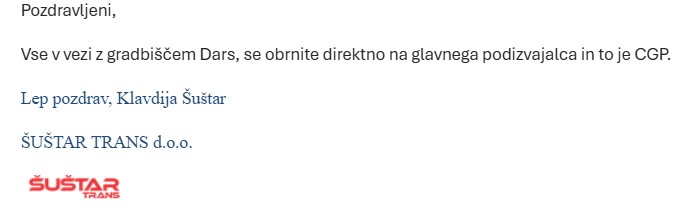
If visibly contaminated bricks were recycled and reused in construction projects, serious questions arise regarding the safety, quality, and suitability of the resulting products.
Šuštar Trans has not explained where these recycled products ultimately ended up.
The company entered the project through Addendum No. 1, under which the planned value of excavation and soil transport works amounted to €560,792.42.
Yet today it remains unclear whether the bricks were carcinogenic or ecotoxic and where any resulting recycled products were used.
Constitutional Right to a Healthy and Safe Environment
Divjak further argues that the constitutional right of citizens to a healthy and safe living environment also requires complete transparency in the handling of construction waste.
“The public should be informed about the traceability of such waste and its ultimate fate. Of particular concern is the unexplained traceability of the excavated brick material, as it is a porous material that, after undergoing the R5 recovery process, may reappear as an uncertified construction product and even be incorporated into public spaces.
If we regard the constitutional provisions guaranteeing the right to a healthy living environment as a serious commitment of the state, then any potentially uncontrolled manipulation of construction waste during building projects must be addressed immediately.
Taxpayers’ money is not an unlimited source of funding and should not support practices that cause environmental damage in addition to financial harm.
Cases such as this require accountability, transparency, and effective oversight by all competent institutions.”
******************************************
SUPPORT US, SUPPORT INDEPENDENT JOURNALISM
Why support us?
Because we are independent of political interests and powerful financial elites. Because people and their rights matter most to us.
In a world where the voices of the vulnerable are too often silenced, and where financial and political pressures frequently prevent important information from reaching the public, investigative journalism remains one of the last safeguards of truth and justice.
Journalism in Slovenia is increasingly constrained by business and political interests. Media outlets are often used to discredit individuals and to settle political scores rather than to serve the public interest.
Your support means more than a donation—it means that you believe in a world where injustices can be corrected. It means that you believe in a world where wealth and influence cannot be used to suppress the publication of important information. Most importantly, it means that you believe in us: that we have the courage to publish everything we determine to be in the public interest.
Your donation enables us to investigate wrongdoing, uncover hidden stories, and protect those who have no voice. It helps us fight corruption, disinformation, and injustice.
Institute for Investigative Journalism and Research
Nanoška 3
1000 Ljubljana, Slovenia
Nova Ljubljanska banka (NLB)
Account Number (IBAN):
SI56 0284 3026 6324 932
Donation

Thank you,
Barbara and Nataša
Preiskovalno.si is an independent media outlet.


