
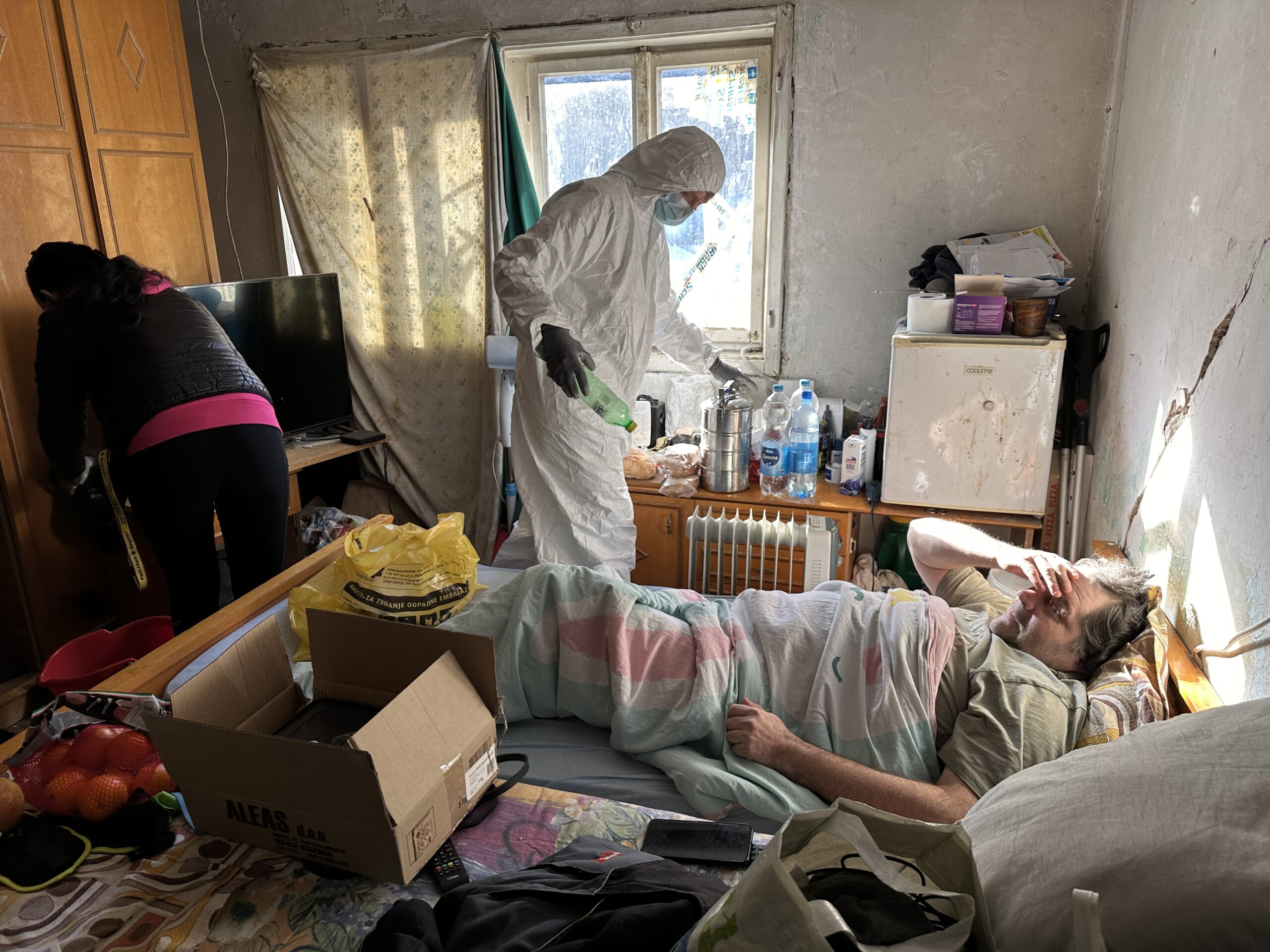
On the edge of the city, where contact with the countryside is already established, we look for an address. Rose Street. The house is the opposite of its name.

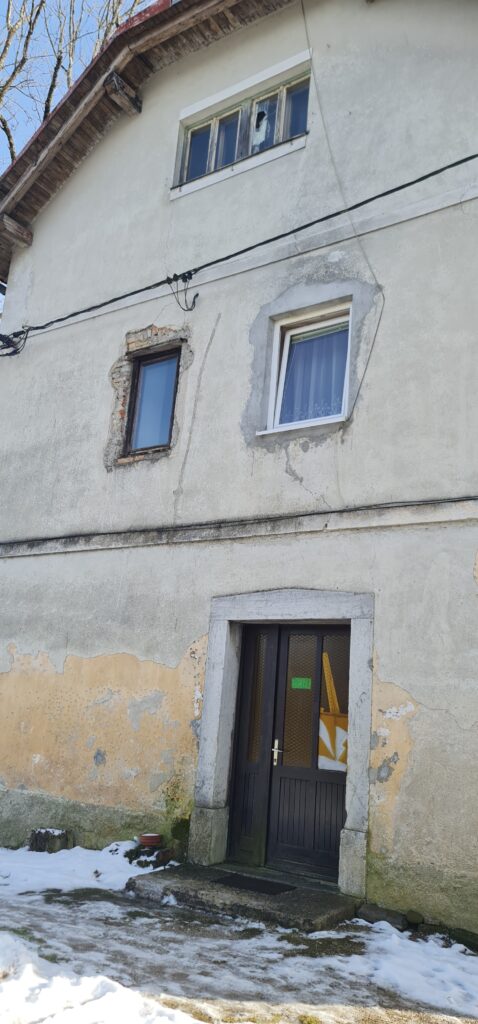
An old, crumbling building with a half-open roof and holes in the windows. It is looking in on itself. We push open the heavy front door and climb the creaking wooden stairs to the attic. Cold, darkness and stench permeate the room. In the only room, a man aged between 60 and 65 lies on a bed. Andrej
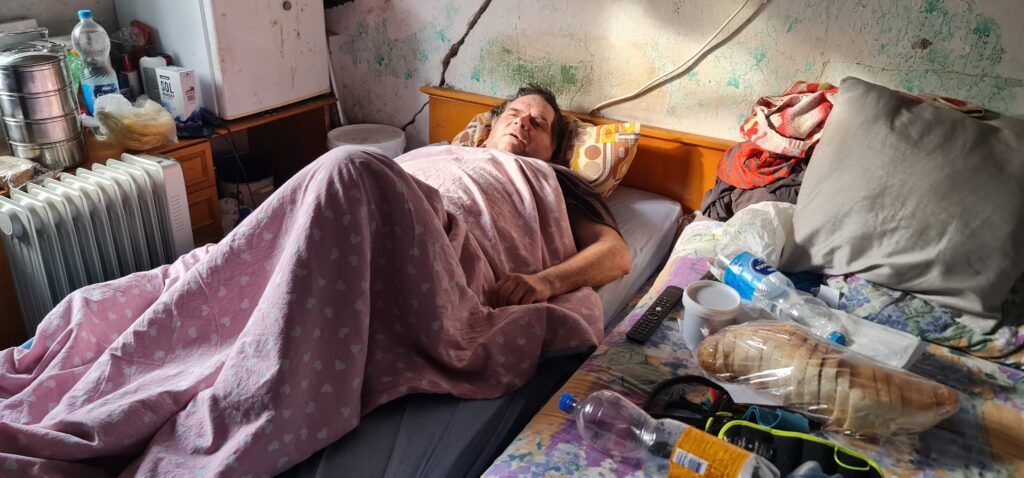
A numb expression on his face. His eyes are staring at the leaky ceiling and the TV is his only window to the world. It’s been four months since he last got up and left his bed. His legs ache, he points to the blue patches on his dry, peeling skin. He cannot stand up. There is no trace of the muscles that have gone flabby from prolonged immobility. He lies motionless. Alone. He doesn’t even know if there is snow outside, because his gaze doesn’t go further than the windowsill. The window pane, cracked in several places, is covered with adhesive tape, from which ice flowers are wriggling. The cold, seeping through the broken glass, spreads through the room. A look around the room reveals nothing but misery. The mould in the corners has already spred to the wardrobe with a few sparse clothes, dampness is seeping in from the cracks in the walls, and rainwater is leaking through the broken tiles, straight through the ceiling. The plaster is literally falling on Andrew’s head
“How is the hygiene, the basic needs?”, we ask, noticing that there is no flush toilet in the room, and that he is unable to go to the toilet himself. He points absently at the pile of plastic bottles by the bed, into which he drops urine. He does his big business into a plastic bag, which he spreads out in a kitchen pot, which he puts under his backside. There is also a closed plastic bucket within arm’s reach, into which he dumps his faces bags.
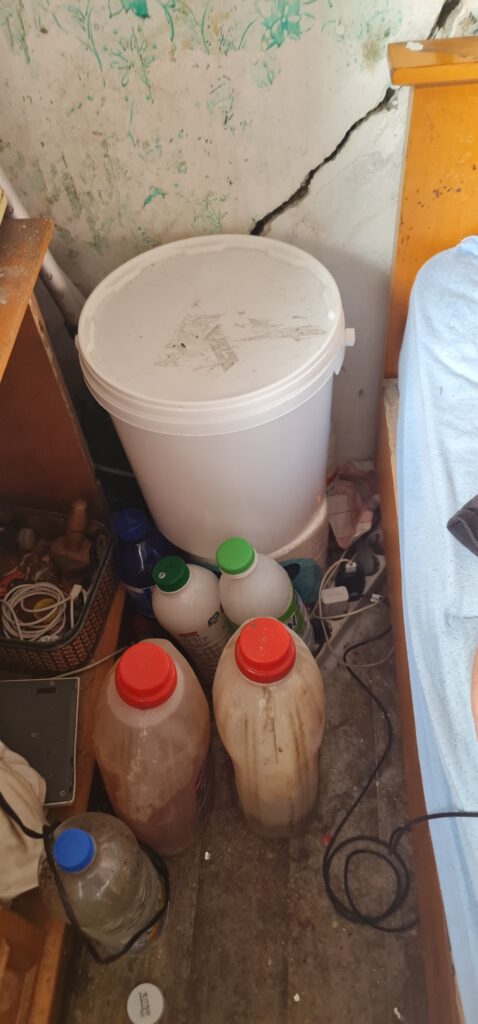
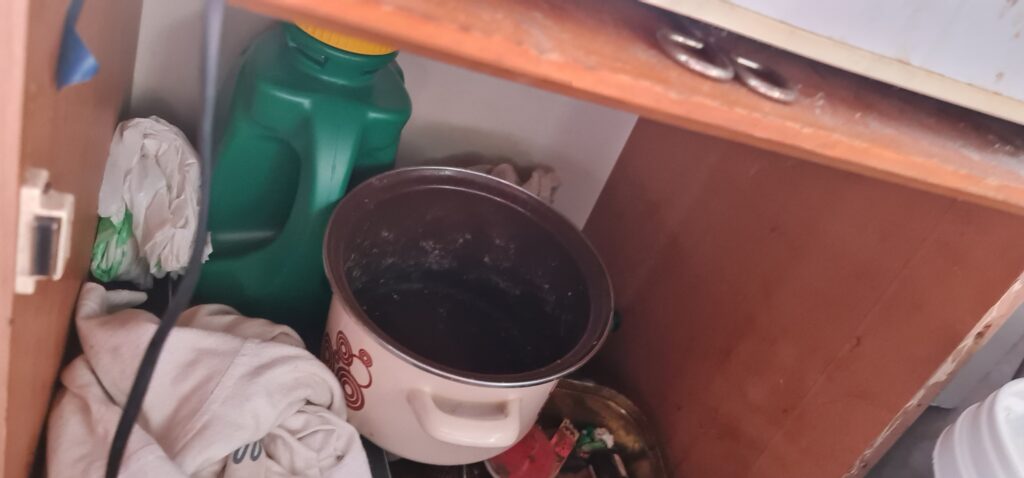
Then he waits for the mercy of one of the few friends who still answer his call to empty the excrement containers. He hasn’t felt water or soap on his skin since September, when he took to bed. He has been lying in bed for 147 days, only wiping himself with wet wipes.
A few centimetres away from the urine and stool containers, we see a loaf of bread, fruit and water. Basic foodstuffs brought to him by his kind-hearted neighbour Slavica. Warm food, he says, he has been enjoying for the last week, when, thanks to his own persistence, his neighbour has managed to win him over after constant letters, calls, pleas and pleading with the public social institutions to get a grip and help this lonely and neglected man. A man who has been in bed for four months without any care, basic health and social assistance. A man who pees and poops in bed, in kitchenware. “I can hear his screams all the way downstairs. I don’t call anyone. A person in this country is all alone, if he has no family, if he has no companion he is forgotten. It’s been like this since September, when he got bedstricken. Until today, there has been no one to see him, to clean him, to provide him with medical care,” says a pensioner in tears who, after undergoing a difficult operation herself, is unable to care for her sick neighbour alone. She only managed to get a hot meal from the home care centre for him for the first time. Although she thought that the social worker would also help her feed him, tidy and clean him up, the woman just put the metal bowl of food down on the coffee table without a plate or cutlery, turned on her heels and left without saying a word. Even as a human being, who, unlike animals, should posses at least a modicum of empathy, the sight of the helpless Andrei did not awaken her compassion.
But it is different when the media gets involved. As soon as we arrive at Andrej’s house, we called the mayor, the social services, and the director of the health centre. They all came to see the forgotten Andrej on the same day.
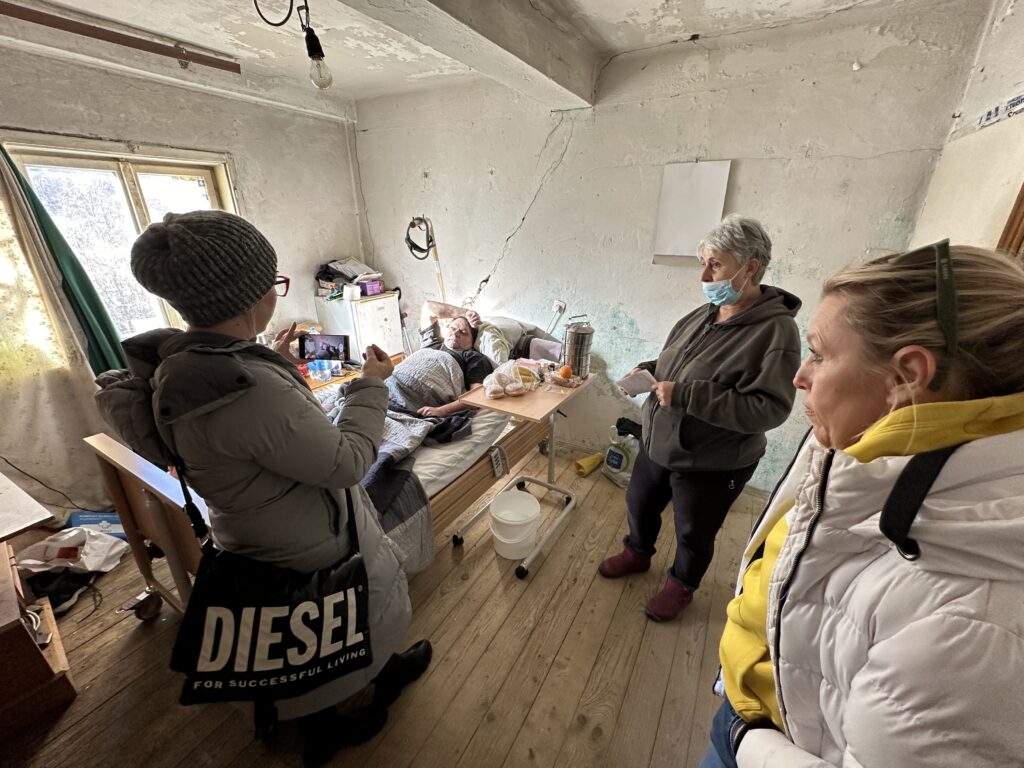
“No one deserves to live like this. This is an outrageous, catastrophic situation! I am surprised and saddened that something like this is happening in our municipality. We will find out who has done this,” said the Mayor of Kočevje, Dr Vladimir Prebilič, who was elected to the European Parliament this year, as he looked at the bedridden, paralysed Andrej. Things started happening fast. On the same day, the wheels of bureaucracy were set in motion so that a disinfection service, a doctor, a medical bed were ordered, and Andrej was prioritized for home care appraisal.
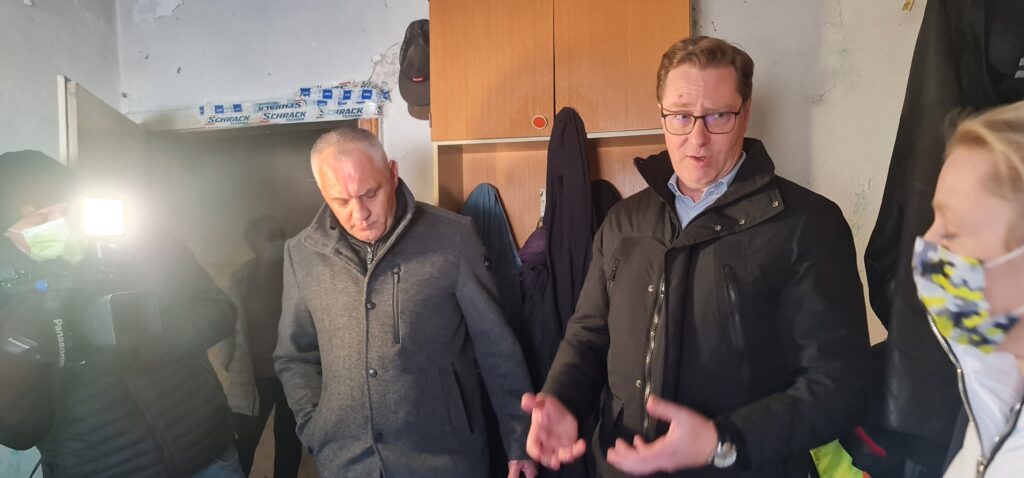
Director of the Health center and the Mayor

Deputy major on the phone
After a long day and a conversation with those in charge about how it is possible that the state does not know how many people over 60 are alone, lonely and abandoned, we went home. We woite. We needed to get the story into the media. The next day we returned to Andrej. Following our article there were already TV crews booked there.
Conscious refusal of assistance from the welfare institute and 11 days since the first response from the social work center
That Andrej was “lazy and alone and to blame for his own fate because he cannot work” was a condemnation that could be heard, even from those, who by mandate of the state or the municipality, should be looking after the elderly. We got a call from a journalist asking us why we were doing a story about a man who had brought his own fate on himself. We looked through the documents and found out that the local home care institution, which is paid around EUR 300,000 a year by the municipality to provide care for the elderly, knew about Andrej, but they simply lifted their hands up?!
WHY?
When they started to deliver his only hot meal of the day, the sight of a non-washed, helpless and immobile man did not stir their empathy. We wanted to know the reason for this indifference and dereliction of duty, which could be grounds for criminal prosecution. During an interview with the director of a home care institution that receives state money to provide care for the elderly, we learned that ‘the conditions of safe work for the employees have not been met’, that ‘it is dirty in there’ and that the rights of the employees are above the right of the user to assistance.
That is why Andrej was literally rejected. Indeed, Andrej’s flat was abandoned for at least 4 months, full of rubbish and burnt dishes. Everyone who stepped inside raised their hands. It was like a rubbish dump.

But the story of 61-year-old Andrej, who never married and never found his soul mate, is a story worth hearing. He was born around 1964. When the Berlin Wall fell, he was 25 years old. He was active in civil society during the Balkan war. He was active in Slovenia’s independence in the Territorial Defence, as he says in Kočevska Reka. He never got married, he took care of his sick brother until his death, and after that, he had an accident. He told us, that he was very attached to his mother and it was hurtful when they both passed away. Short after that he had an accident and could no longer work, he simply laid down. Alone. One day his loud cries of pain called to him his golden neighbor, Slavi, who called us – the smallest medium in the country.
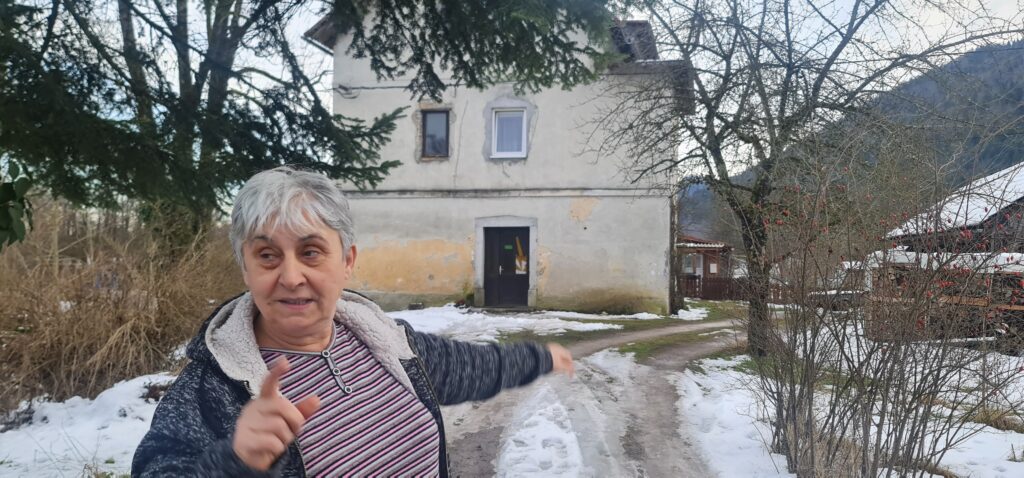
Neighbor Slavi with golden heart
THE INITIAL EFFORTS TO ASSIST ANDREJ VIOLATED HIS BASIC HUMAN DIGNITY
Following our disclosure, they initally attempted to hastily transferr Andrej to a homeless shelter, where, in a small room for four people, he would also have to do his daily chores in bed, one metre away from the other occupant. He did not agree to this. He preferred to remain alone, he said. And they resented that. Because he did not accept the “generous offer” to go among the homeless and poo and pee in front of them. To be under constant surveillance and after 4 months of solitude in the hustle and bustle, which would have been a shock to him. He turned to us. “I know they want to help, but I can’t accept it”. We understood.
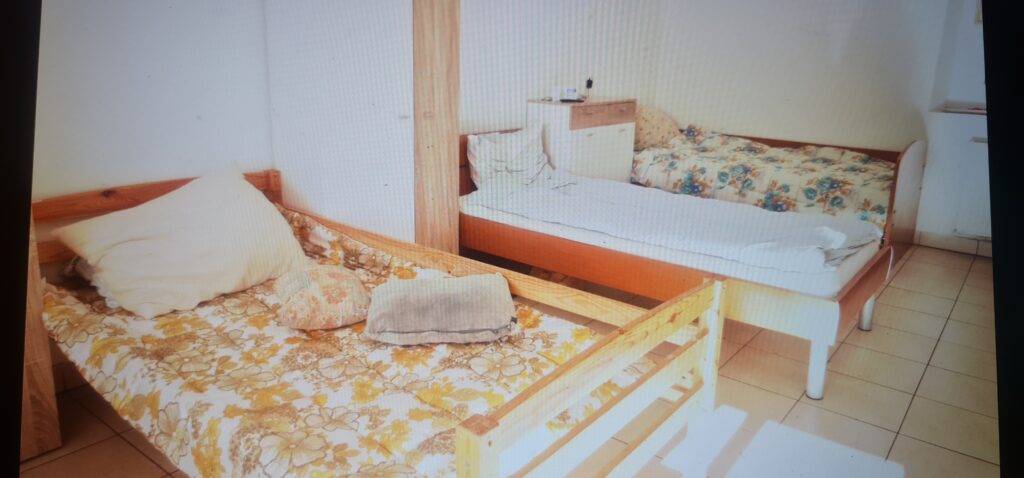
We went to see rooms for homeless. A room with three beds. Andrej said : Thank you but “no”. we understood.
Then came another offer to go to a retirement home. He was also immediately told that, due to lack of staff, his rehabilitation would not be possible and that he would also be bedridden or dependent on his own will. They told him that they would put him in adult diapers, so he would continue to be deprived of his independence. By placing him in an institution, they would also deprive him of financial support and eventually become the owners of his home, as his illness has left him without an income, and he would not be able to afford a home for the elderly. Andrej wanted to stay at home, but also wanted to get well. Is that too much to ask? “It isn’t,” we told him, as did his neighbour Slavi. And because he didn’t want all this help and cuts to his basic rights, rumours began to spread that he was refusing help. Andrej’s only wish all along was to get back on his feet and to find some work. His neighbour Slavi was determined to arrange help to get Andrej back on his feet.
MEDICAL REPORTS
A few days later, the results came back. Andrej had no specific life-threatening illnesses and should be able to walk again. But the queues were unbearable. One waits for the physiotherapists for a very long time. But Slavi did not wait. She called a physiotherapist from neighbouring Croatia, who started with Andrej first lying down to exercise and then gradually sat him up. The path to walking again was a long one. The physiotherapist was paid by Slavi and soon he got another therapist from the state. The recovery was accelerated…
The impact of the media in drawing attention to fundamental human rights became clear when we insisted that they find a different, more appropriate solution for Andrej. After our first visit to him, just a few hours later, the Mayor and Vice-Mayor of Kočevje and the Director of the Health Centre were standing by his bedside. Serious negotiations were underway to save him. In less than 24 hours, Andrej got a proper hospital bed, which was needed for his care.The director of the health centre insisted that Andrej was seen by a doctor and sent to Ljubljana for specialist examinations. The municipality had the attic cleaned and de-wormed, and Red Cross volunteers brought the flat up to at least minimum living standards. Local craftsmen, however, when they heard about Andrej’s story in our media, started coming as well. Most of the credit goes to a selfless neighbour and her husband, who promised to make a new room for Andrej with workers and a few volunteers.
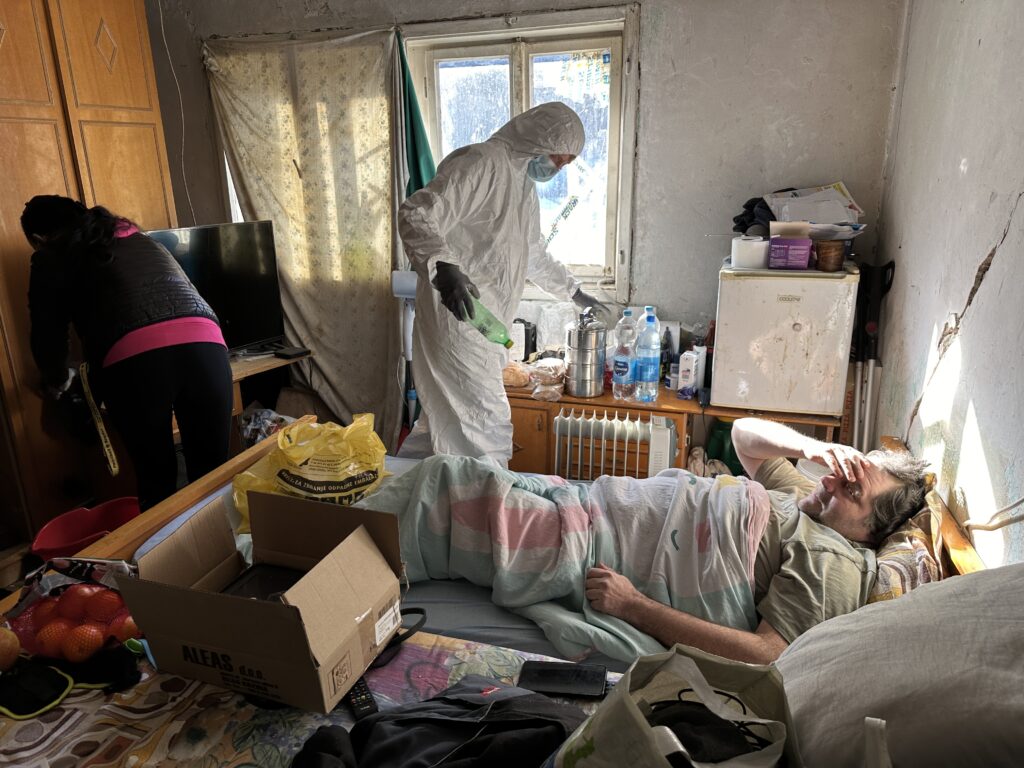

The work started, and within a few months Andrej had moved from his bed to a wheelchair. We both took notes and followed the story regularly. We promised to stay with Andrej until he got well on his new path in life. The new room was getting fresh paint in ever brighter tones, new floors, a new sink, wooden elements and furniture.
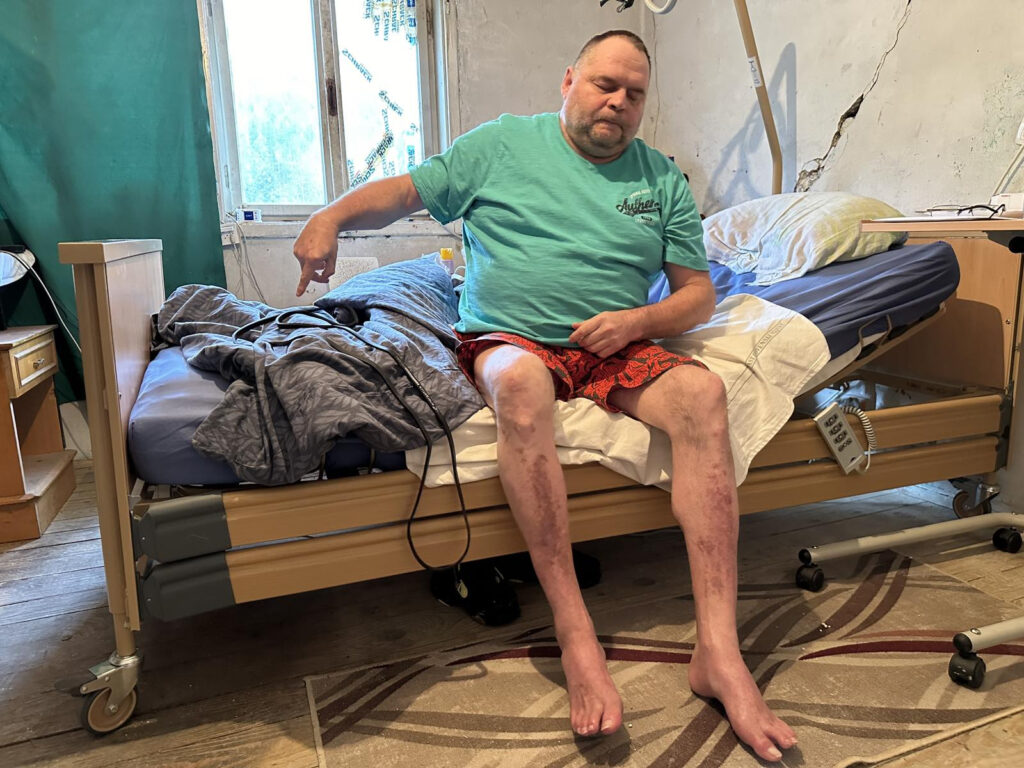


It seemed that Andrej’s life was gaining new dimensions. For the first time in months, he was combed and got a haircut.
After things turned up for Andrej, we started to wonder how many more Andrej’s there are in the same municipality of Kočevje, which has 15 thousand inhabitants. How many in our Slovenia, how many in the entire European Union?
FOLLOW THE NUMBERS

After Andrej, four more elderly people, left to their own devices, were found in the municipality of Kočevje. This is what we were told by the Centre for Social Work. A breakthrough has happened. Five Andrej’s were rescued, we dared to write. Because we didn’t give up when they said he was lazy and that it was all his own fault. The mayor was also happy.

Ex major Vladimir Prebelič was very helpful and active
So we realised that Andrej is not an isolated case of elder neglect in our country of two million people. How many are there – this was the question that kept nagging at us. First of all, we need to find out how many elderly people live completely alone. Does the state even have this data? These are people who may be without a doctor, and without care. Without contacts. The only statistics available were for 2021, the last time there was a census, and they showed that there were 114 887 people aged 65 or over living alone in their households. This represents a quarter or 26% of people aged 65 and over. Although they are hidden behind the anonymity of statistics, these are people, our neighbours, acquaintances, peers. Have any of the decision-makers asked themselves whether they have anyone to bring them a glass of water, offer them a hot plate of soup, wash them or turn them in bed? Maybe just provide a pat on the back or a word of sympathy?
How slow is the bureaucratic apparatus if we are getting information about the year 2021 and if Andrej started to be hugged by the competent institutions 11 days after the first call from his neighbour to the social work centre? This despite the fact that we have a unique ministry in Slovenia, the Ministry of Solidarity-Based Future, dedicated to the elderly.
We were told that “these people are regularly visited by the social work centres, which run programmes, the most important of which is the Seniors for the Elderly Project, run by the Slovenian Association of Pensioners’ Associations (ZDUS). This project involves visiting the elderly, where volunteers check their living conditions and, if necessary, inform the competent services of any problems.” But this is just a bit of lip service. There is no systematic checking of the isolated. And this in our young country, which, like the rest of Europe, has subscribed to ensuring fundamental human rights. As a member of the Council of Europe, we have committed ourselves to “uphold the social standards enshrined in the Social Charter and other instruments of the Council of Europe.” If a small country such as ours cannot get data on the lonely with one click on a population table, how can it be in Romania, a much larger country of nineteen million people, we started to wonder. How many Andrejs are there?

National flag on the top of a hill near Barsov, bare trees, low clouds, cityscape, Romania//FREEPIC
Romania has also committed itself to respecting human rights. If you can drive across Slovenia in just over three hours and reach practically every corner of it in a day, being old in Romania is much worse. The picturesque landscape, interspersed with mountains, plains and hills in between, makes it impossible to control the elderly, who remain in their homes in remote areas from birth to death. The Margareta of Romania Royal Foundation, which cares for the elderly, told us that there are 3.7 million people over 65, one million living completely alone, and a further 2 million widowed, divorced or unmarried. Who is keeping an eye on the fate of these people? Are they really just statistics from Eurostat? In Romania, the average pension is a measly EUR 400! Slightly stronger painkillers cost more than EUR 4. Who buys and delivers them? Who puts the pills in the distribution box, to sort them by days? Who controls the drug interactions? The Romanian Foundation is one of the few that cares, monitors and helps these people. They probably will not reach all the lonely and needy elderly people who have no one else in the world, even in 2026 and 2027. Millions of Andrejs in the middle of the most developed part of the world.
Eurostat warns of social exclusion of older Europeans
Deprivation, illness and loneliness are the biggest problems facing older people in the European Union, Eurostat warns. At the height of the technological stampede and with billions to spend on armaments, those who built the modern Europe of peace have no one to bring them a glass of water.
Andrej is the symbol of all the lonely, neglected and forgotten Europeans. He is the voice of the nameless masses from Spain, Germany, Poland, Ukraine to Greece. He is part of the generation that defended our European Union, made it independent and kept it in peace. Today, Germany has a little less than 20 million people over the age of 65. In addition to Germany, Italy (13 million), France (13 million), Spain (9 million) also have high proportions of older people. These are our parents, our grandparents. As many as 21.8% of men over 65 in Europe live completely alone. Who covers them, who brings them their pills, who makes them a hot meal, who changes their diaper?
58% of men over 65 in Europe share their home with another person, while the figure for women over 65 is slightly lower at 39%. 40.2% of those over 65 live completely alone, according to Eurostat estimates.
Older people in the EU urgently need a dedicated Commissioner
92 million Europeans are old! This is a quarter of the population that defies the paradox of modern times. The expansion of social media, networking and liking is felt at every turn, but the builders of Europe are socially, existentially, healthily and emotionally isolated. While the 448.4 million inhabitants of the European Union are able to exercise their needs and rights under the auspices of 27 Commissioners for different areas, the elderly remain neglected. In five years’ time, could a Commissioner for the elderly be added, rules be standardised, records be made and kept? If we have censuses of people, cars, dogs, could we also take care of those who are alone and lonely? For those who have not managed to build a basic social unit – a family. For those who are left without that cell. For a Europe of solidarity, without Andrejs in the future. Could we add a dedicated Commissioner? For the generation that paved the way for peace, for human rights, for progress, for technology. Every single Andrej deserves it.
ANDREJ!
We have been visiting Andrei for almost a year. When he took his first independent step, he sent us a recording of that.

It was as if his own child started to walk, we felt so happy. We visited him the day after. And a week later and a month later. Step by step.” When you can get down the creaky stairs let’s go for coffee!”
A month later the phone rang. “Come on, reporters, come on, let’s go for coffee”. He was waiting for us at the door of the house!

We drove with his neighbour Slava to a nearby lake where he wanted to go. There was an indescribable feeling of happiness. Andrej also became well known to everyone, people stopped and greeted him.
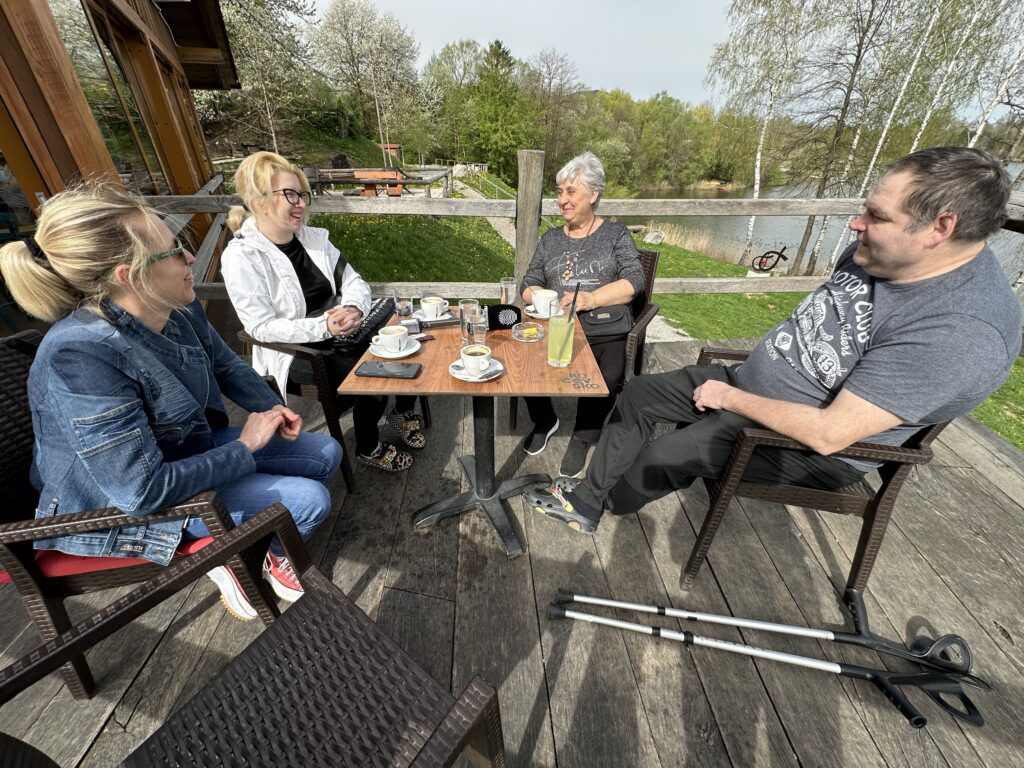
Next wish? A car, a trip, the feeling of freedom.
A few months later, he went to the seaside.

The state also provided him with rehabilitation. He waved at us in recordings and photos from the pool, the gym and places he hadn’t been in a long time.

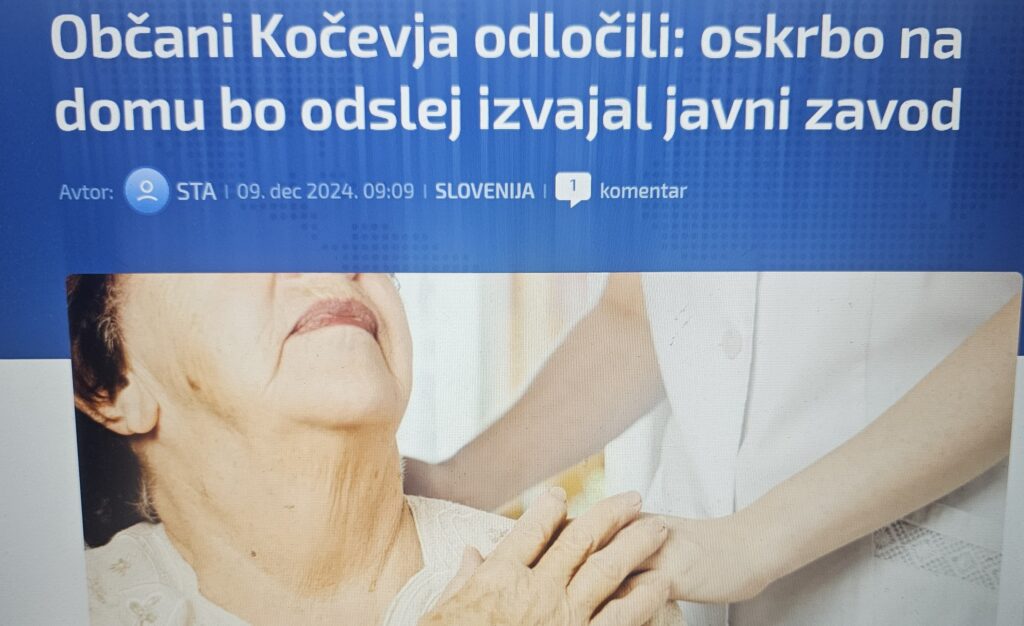
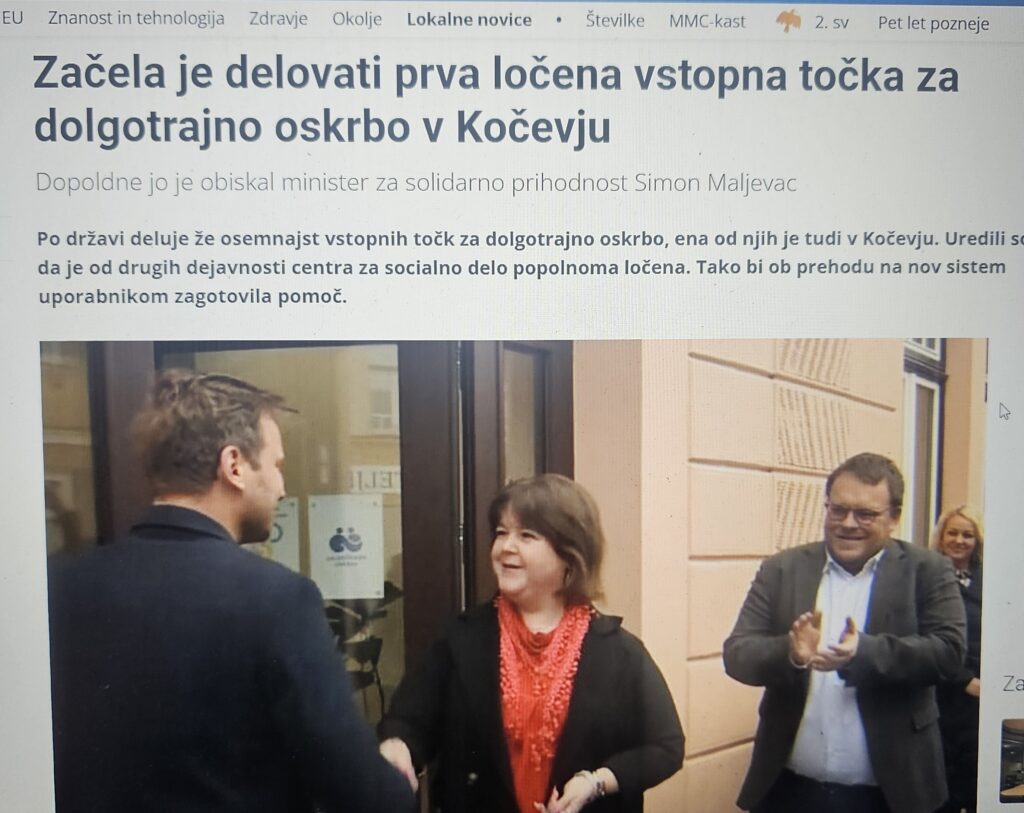
After our report, the municipality revoked the license of the institution that was supposed to care for Andrej, and notice that he was lying in his own faces. They established a new facility to care for the elderly in the municipality. That was also our victory. Andrej’s hometown of Kočevje became the first town where the municipality established its own institution for elderly care. The municipality also became one of the entry points for the new long-term care legislation.
Andrej’s story is not one of downfall, but of resurrection. It shows that sometimes we show our greatest strength when we are most vulnerable. And that life is not over as long as there is someone who still believes in you.

Andrej and two journalists Barbara Pance and Natasa Markovič


