
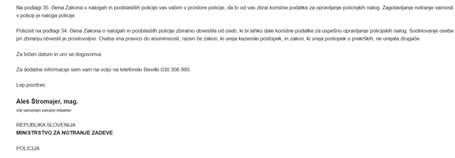
December 1st: 2025 CALL TO THE POLICE
“Pursuant to Article 35 of the Police Tasks and Powers Act, I invite you to the police station to clarify the circumstances.”
Signed by: Aleš Štromajer
Senior Independent Police Inspector
24 DAYS EARLIER
November 7th, 2025 KUKMAKA: A HIDDEN ECOLOGICAL BOMB
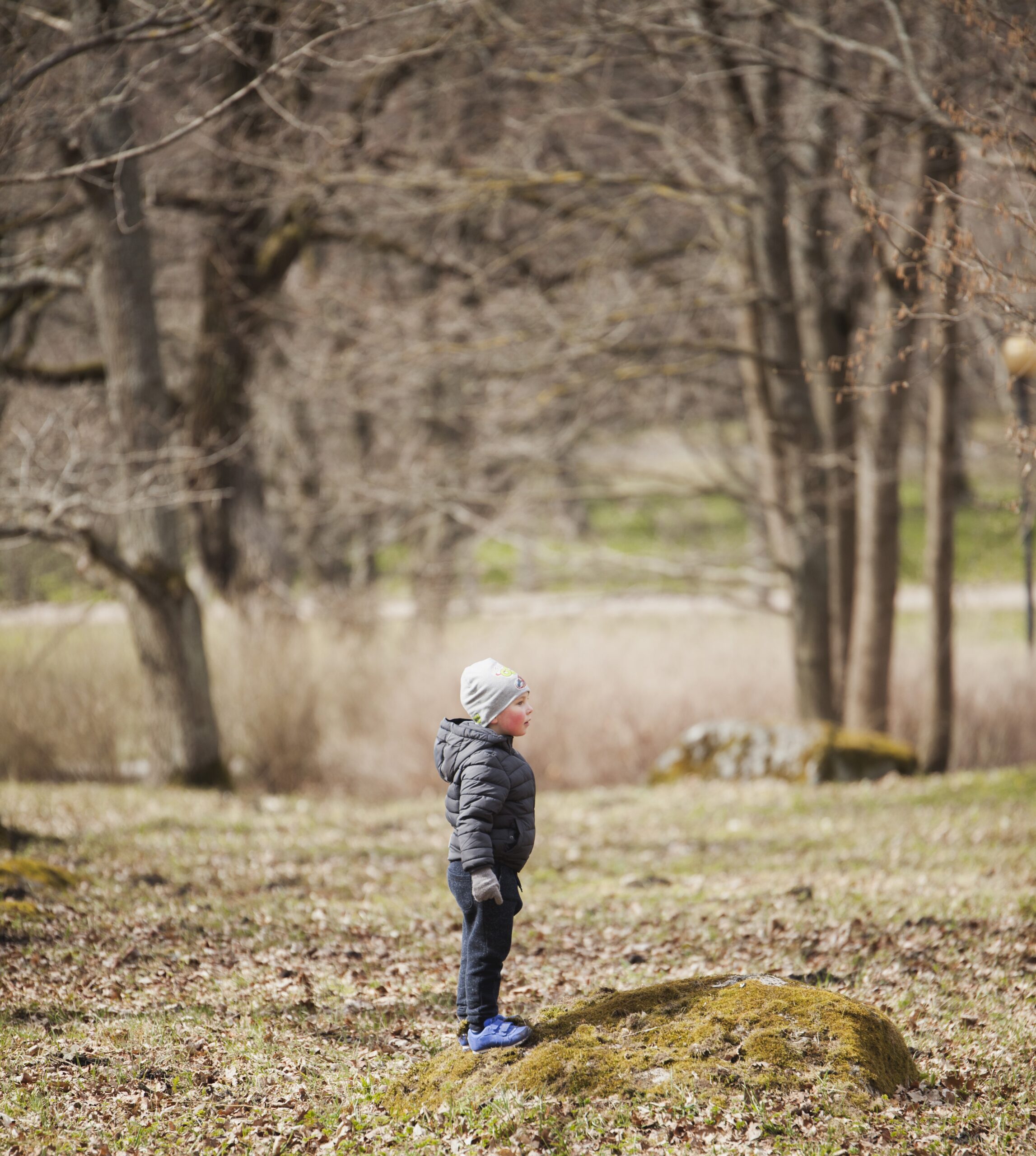
The three children from the Grubelnik family are running around a nearby hill in the village of Kukmaka in the municipality of Velike Lašče. They run down the hill, across the meadow, and back up again. In the summer, they extend their game to the stream, where they splash around carefree. Their father, Tomaz Grubelnik, is at home; the house is only a few dozen meters away from the hill where his children are playing. When we inform him of our findings, he is there. He confides in us that they moved to the village of Kukmaka so that their children could grow up in a clean, natural environment, where they could spend most of their free time outdoors. At least until now, they have. Until our investigation, they did not know that an ecological bomb was hidden in front of their homes.
Nothing in the Kukmaka area suggests any danger. Nature appears unspoiled. No one suspected that this picture of family life would be shattered by a journalistic investigation and turn their family idyll into a fight for the right to a healthy environment. The hill where the Grubelnik children play with their peers from the village is green at summer; covered with oats, which farmers use for rapid greening. Publicly available data show that this is prime agricultural land.

But historical satellite images from Google Maps tell a different story. The hill is man-made. Beneath it lies buried waste. Some of it is poisoned
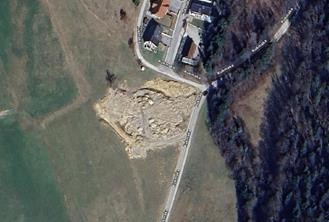
From the moment the Grubelnik family learned that construction waste, including hazardous waste, was buried less than 10 meters from the first house in the settlement, other families also forbade their children from leaving the house to play outside.
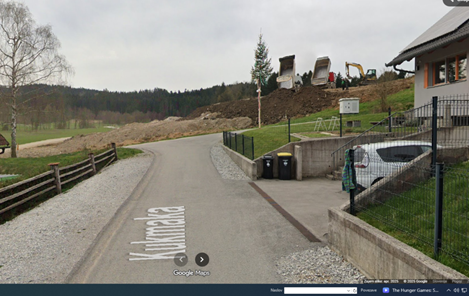
As recently as April 2025, open-source footage recorded an excavator burying the load and covering it with soil. The documents we obtained show that approximately 40 trucks, each carrying between 20 and 25 tons of construction waste mixed with hazardous waste, were illegally brought to the area.
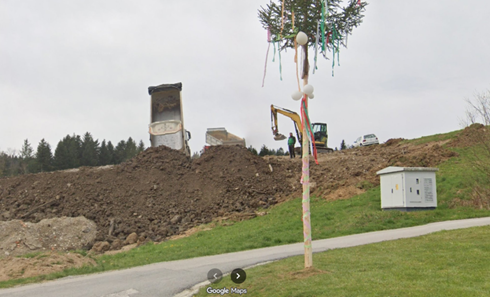
Children played there every day, digging their fingers into the ground and inhaling dust mixed with toxins. The Grubelnik family was unaware of the danger.
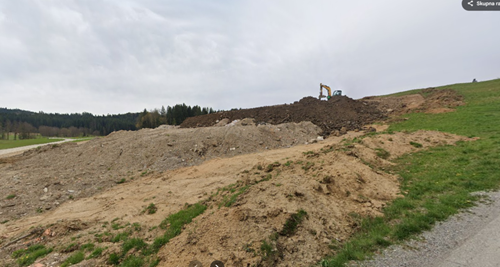
At the illegal landfill in Kukmaka, the Slovenian Environment Agency measured Nickel levels between the warning and critical values. A whistleblower sent us a document in which heavy metals exceeding the limits are marked in red. The levels of Copper, mineral oils, and PAHs (marked in yellow) are also elevated. It was around this document that the story of environmental crime and systemic corruption in the country began to unfold.

This environmental crime was concealed from the people in the immediate vicinity by all the relevant institutions in the country, even though they were aware of it. These institutions include the Ministry of Justice, the Ministry of the Environment, the Environmental Inspectorate, and the Environment Agency. This is where the investigative story began.
WHERE DOES THE WASTE COME FROM?
The question was no longer what was buried in Kukmaka, but where did this waste come from and why did the Environmental Agency sample it in the first place? Our investigation found that Kukmaka is not an isolated case.
According to our findings, the waste was generated during the construction of the new Dobrunje prison in Ljubljana. Before construction could begin, the former landfill site had to be cleaned up. Instead of going to waste disposal centers, 840 truckloads of construction waste from Dobrunje ended up at 32 locations across Slovenia.

Each truck carried between 20 and 25 tons of waste. This has been confirmed by all the relevant institutions.

One of the inspectorate’s documents states that GPS trackers showed 840 transports to various (illegal) locations across Slovenia, where waste was disposed of between March 1, 2023, and July 3, 2024, on the basis of falsified documentation.

According to the documents, construction companies were responsible for the waste. The contract for the construction of the state-of-the-art prison was awarded to a consortium of three companies: CGP, Kolektor Koling, and Pomgrad. The owner of CGP is the richest Slovenian, Dari Južna, who also owns media outlets. The construction company Kolektor also controls one of the oldest and once most prestigious newspapers, Delo. The contract with the state was worth €90 million.
10. 11. 2025
HAZARDOUS WASTE 200 METERS FROM THE SCHOOL
During the investigation of illegal landfills, we drove along difficult-to-access forest roads. We crossed municipal boundaries.
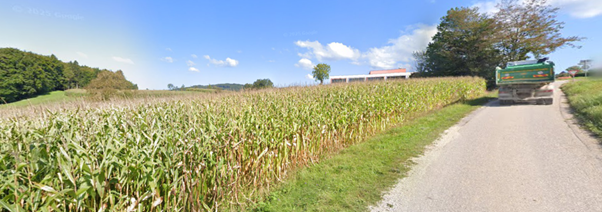
Some locations were hidden, others were not. Below is the village of Polica near Grosuplje. Just 200 meters from a school attended daily by 150 children from grades 1 to 5, there is a new illegal waste site next to a forest, right next to agricultural land.

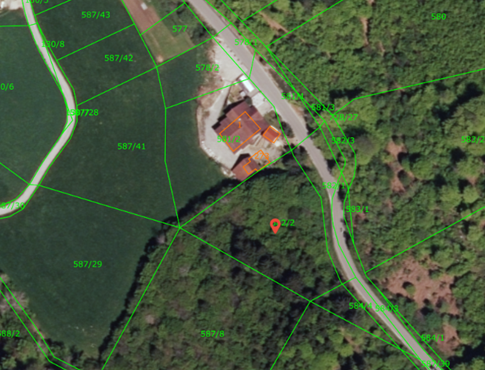
Ten years ago, this location was covered by a rich forest, as we can see from this historical satellite image:
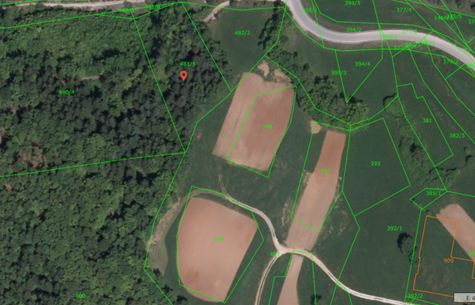
Below is this year’s satellite image from Google Maps, which shows the deforestation. For the purposes of the landfill, the forest was cut down and around 100 truckloads of construction waste were buried in the area, in which soil sampling analysis revealed the presence of zinc between warning and critical levels and elevated levels of copper and mineral oils (as shown in the table above).
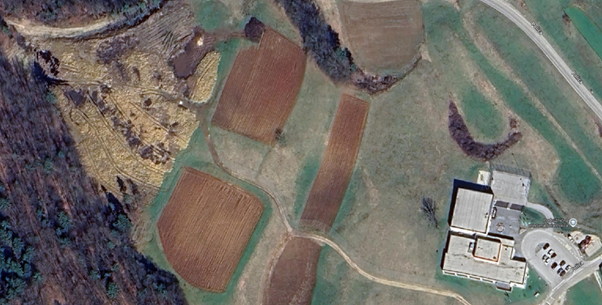
After we sent them several questions and photographs, the Environmental Agency confirmed that this was an illegal landfill site. And in the immediate vicinity of the hazardous waste site are prime agricultural lands with fields and corn crops intended for food.
The transporter Anton Grandovec is from this area. His name first appears in documents where builders had to write down who the subcontractor would be. Grandovec confirmed to us that he is a subcontractor in the construction business of the richest Slovenian. He admitted that last year and the year before, he transported waste to the locations we revealed. He admitted to systematic violations of the law: “We all commit offenses, we don’t have environmental permits everywhere, and everyone knows that. Theoretically, it is impossible to do what the inspectors want. The process for obtaining an environmental permit takes at least six months to a year. But when you take on a project from a builder and sign a contract, you have to start work immediately, so it’s impossible.”
Video
Construction waste was dumped illegally so that they would not have to pay the costs of obtaining environmental permits for processing and disposal at official collection sites. All permits are expensive, and the procedures for obtaining them are lengthy. Therefore, they circumvented the rules and dumped the waste in nature, even paying some farmers to do so
OTHER LOCATIONS
The documents we obtained indicate 32 illegal locations where subcontractors involved in the construction of the Dobrunje prison in Slovenia dumped waste mixed with hazardous substances into the natural environment. We reveal 14 of them on our portal.

LJUBLJANA
In August 2023, catastrophic floods occurred in the capital, where the prison was being built between 2022 and 2025. The Sava River overflowed its banks in the Sneberje neighborhood of Ljubljana and flooded houses. The mayor and the government promised residents an embankment along the river. This is what the riverbank looked like before the floods.

The new embankment (below) now blocks the view of the Sava. It stretches 350 meters along the right bank, directly adjacent to the rapids. It was built using construction waste. The project cost the state €350,000.

The Hidrotehnik company is responsible for managing the middle Sava area, and according to media reports, the state is allocating millions to this watercourse. From 2023 to the present, the Directorate has already transferred almost €110 million to Hidrotehnik. Payments began to increase after the floods. And who owns the company? The same person who built the Dobrunje dam! The same person who is responsible for the removal of construction waste.
HIDROTEHNIK = DARI JUZNA
CPG = DARI JUZNA
The owners of Hidrotehnika are Dari and Vesna Južna through CGP and affiliated companies. First, they got the contract to build the prison Dobrunje, buried the construction waste in nature, and used some of it for flood protection embankments, thus earning money a second time.
According to estimates, 4,500 cubic meters of soil were used for the embankment, and according to our reliable information, some of it came from the Dobrunj area.
We asked Anton Grandovec if he had transported waste from Dobrunj there. He replied: “If I did, it was processed material from dams and not construction waste directly. ” However, this is not true, as we learned from environmental inspectors, “the waste was not processed before disposal.”
ILOVA GORA

This is the location on Ilova Gora. The photo we obtained is from 2023, and you can still see the excavator that buried the waste. They are still there.
LUČE
We discovered this location in Luče, in the immediate vicinity of a settlement with large farms where people are engaged in livestock breeding and agriculture. Under this embankment are meadows and fields, a karst landscape with numerous sinkholes that flow into the Krka River.

An orthophoto image from 2021 shows that there used to be a forest in this area. The trees were cut down and waste from Dobrunj was dumped into the ravine, as confirmed by the driver who drove us to the location in Luče.
Buried waste poses a threat to public health, says Dr. Metoda Dodič Fikfak, a relentless doctor at the Ljubljana Clinical Center. “Hazardous waste must be removed immediately and disposed of at designated landfills where nothing is grown. Nickel, zinc, copper, and PAH are elements that do not disappear. They remain in the soil for decades and pose a risk even if the soil is used for agricultural purposes over time. It is therefore essential that such material be removed and disposed of at specially designated hazardous waste disposal sites. If you just dump this soil, forget about it, and then carry out normal agricultural activities there, it can be extremely dangerous. If someone wanted to grow organic vegetables on such soil, it would be a big problem—plants absorb metals, and these remain in the crops.

Dr. Metoda Dodič Fikfak
In the municipality of Grosuplje, we discovered three illegal waste sites in addition to the landfill in Polica. The illegal landfills are located in a landscape park rich in groundwater that flows into the Krka River. In addition to the landfills, which are now covered with grass and bear no resemblance to construction waste dumps, we also came across harvested grain fields and fields for growing crops.

Since the Environmental Agency has not taken soil samples from them, it is not known whether hazardous waste has also been deposited there. Due to the health and environmental risks, after our weeks-long investigation, the locals sent a request to the Municipality of Grosuplje to take immediate action by: “requesting measurements and probing, ordering weekly water sampling from the municipal utility company for possible hazardous substances, submitting reports to the competent inspection authorities and criminal charges against the perpetrators and landowners for all four locations, marking the areas as hazardous to human health, animals, and the environment, and calling on farmers to stop using agricultural land near the landfills until the situation is clarified.”
A meeting has already been convened:
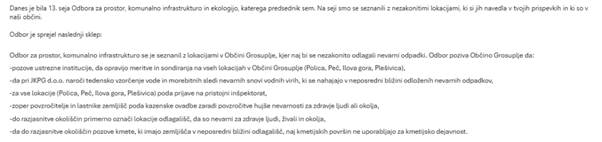
The mayor of Grosuplje has promised Preiskovalno.si that they will take action and protect human health. Local residents have also started collecting signatures for a petition.
Following our disclosure, the residents of Kukmaka are also demanding excavation, removal, remediation, and accountability from all those involved. “The waste must be removed. Those responsible must take responsibility. We will do everything we can in the village to ensure that those responsible are held accountable.” They are also connecting with residents of the other disclosed locations. So far, we have discovered 14 of them ourselves.
Official responses about the remaining locations are sparse and shrouded in GDPR due to private owners of agricultural land who allowed builders to illegally dump waste on their land. According to our reliable information, most owners agreed to have waste buried on their (agricultural) land in exchange for money. It is unclear whether they knew that some of this waste was hazardous.
PASSING THE BLAME
Based on data on the history of truck trips transporting excavated soil from the construction site of today’s Dobrunje prison, the Environmental Inspectorate found “that the waste was not taken to an authorized recipient, as stated in the records, but was dumped at various locations throughout Slovenia. Thirty-two to thirty-four locations were identified where vehicles returned from the construction site on multiple occasions, indicating suspected illegal disposal of excavated soil.”
As part of the inspection procedures, six locations with illegally dumped material from the construction pit in Dobrunje have been investigated and officially confirmed so far. The other locations have not yet been inspected. They added that “proceedings for the remaining locations are still ongoing, so no further details can be disclosed at this time,” according to the Environmental Inspectorate, which has issued four inspection decisions in connection with the irregularities found. According to our information, the first relates to subcontractor and transporter Roka Remca, who accumulated waste on his land. The others relate to decisions imposing waste removal.
The inspectors are not disclosing the names of the individuals involved in environmental crimes to us due to personal data protection (!). Even though this is a matter of public interest! It is known that most of the waste was removed by Anton Grandovec and Rok Remec from the company Odpadne surovine. These are repeat offenders in the field of environmental legislation, as has been reported in the media on several occasions. Anton Grandovec denies that he illegally transported waste to illegal dumps, even though his trucks were equipped with GPS trackers, and analyses of these trackers confirmed that they were transported to areas where construction waste should not be legally disposed of. Rok Remec admitted to us that he had transported waste to two locations, but that he was “in the process of cleaning up these dumps.”
The Minister of Agriculture Mateja Čalušič told our portal that dumping waste on agricultural land is unacceptable and referred us to the relevant ministries.
Two months before the operating permit for the prison was issued, the Minister of the Environment raised several objections, including requesting an analysis of the excavated material from the investor, the Ministry of Justice, and evidence that the construction waste was non-hazardous and where it had been taken
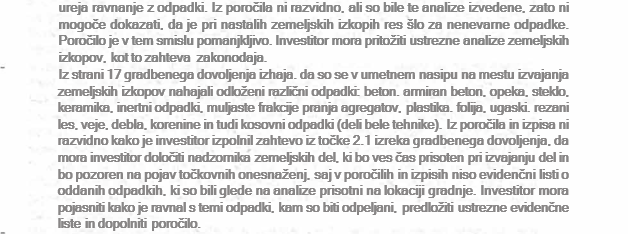
Excerpt from the minutes of the technical inspection of the Dobrunje prison facility, 28 August 2025
Despite the findings and analysis of samples by the Environmental Agency, which showed that at least two cases involved hazardous waste, two months later they stated that “all deviations had been appropriately corrected or explained. The irregularities for which the investor was responsible have been rectified.” However, as we reveal below, this is not true, as the police and the public prosecutor’s office have already launched an investigation, and the environmental inspectorate has informed us that 19 inspection procedures are underway due to the falsification of records.
November 10th. 2025 DISCLOSURE PRICE: POLICE
On this day, we were investigating locations near the home of one of the waste transporters. Just four minutes after filming the location with discarded waste in the middle of the city, the journalist’s husband’s phone rang.
Time: 12:08

An unknown voice on the other end said, “Two young ladies are filming my property. I’m coming to settle the score.”
Someone had obtained personal information from the license plate. We reported the abuse to the police, so they conducted an internal investigation and, as we wrote at the beginning, senior police officer Aleš Štromajer “invited us to clarify the matter” so that they could find the police officer who had illegally looked at our personal information. Phone calls with warnings such as “stop digging, or there will be trouble, it won’t end well” continued in the following days. Finally, someone with a southern accent called and warned us to stop reporting.
POLITICAL RESPONSIBILITY AND INFLUENTIAL ECONOMIC NETWORK
November 12th 2025
On this day, the Ministry of Natural Resources and Spatial Planning quickly issued a permit for the prison. They announced that prisoners would be transferred there in January 2026. Every day, there’s a new lawsuit about crowded Slovenian prisons. And they didn’t hold back. We’re revealing some fake documents that three ministers knew about. The Minister of Natural Resources Joze Novak , Minister of Justice Andreja Katič , the Minister of the Environment Bojan Kumer.

Minister of Natural Resources, Minister of Justice, Minister of the Environment
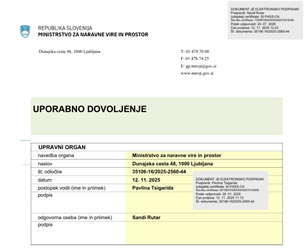
Permit for use
LEGALITY OF DOCUMENTS FOR ISSUING A USE PERMIT
At Preiskovalno.si, we turned to construction and environmental experts to verify the legality of the documents. We forwarded several allegedly forged documents to the non-governmental organization ROVO for review and confirmation of our hypotheses. They found that “the handling of construction waste was systematically improper and deliberately concealed, that the documents were incomplete and misleading because they lacked key information such as the carrier, the exact location of disposal, and the type of waste, which makes it impossible to trace the waste. That the locations are fictitious and the waste is disposed of without permits from the Environment Agency and environmental permits.” This means that “the documents conceal the actual situation. This is more than an environmental crime!”
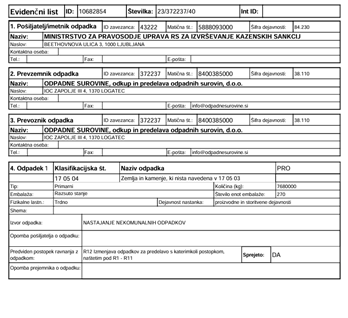
As soon as we started asking uncomfortable questions about this, the Ministry of Justice and the Environment managed to retroactively arrange all the documentation and issue a usage permit. At the same time, they also confirmed to us that criminal charges had already been filed against individuals by the Slovenian Environment Agency in January. As we learned, this concerns a subcontractor who transported waste and public officials. State institutions have confirmed all of our disclosures.
A FRIGHTENING MEDIA SILENCE
It is not only the economic and political network that plays a key role in this story, but also the media, which is owned by the builders who polluted nature and earned millions for themselves in the process.
CGP, one of the three companies that won the contract to build the prison, is owned by the Južna couple. They are not only a powerful player in the construction industry, where millions of state funds are at stake. The owner of CGP, Dari Južna, is also the largest private shareholder in the state-owned energy company Petrol, which is a major advertiser in the media. The Minister of Economy also has a stake in Petrol. According to a recent survey by Finance magazine, the Južna couple have risen to the top of the list of the richest Slovenians this year, with assets of €511 million. Through two holding companies, Vizija, they own the construction company CGP, the Novo mesto printing company, the Lisca underwear line, the companies VGP Novo mesto and Hidrotehnik, which was one of the main contractors for the restoration after the catastrophic floods of 2023.
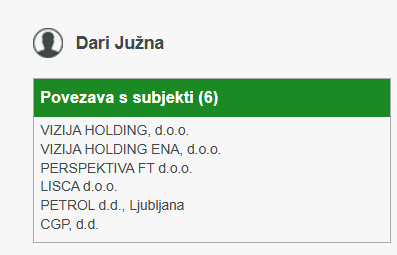
EBONITETE.SI
This is CGP Darija Južna’s revenue from public funds over the last 10 years. Južna’s business with the state in construction projects has been growing in recent years.
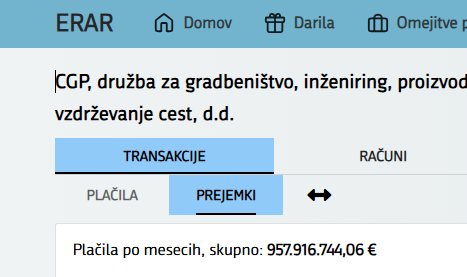
Information from public transaction centre: ERAR
The richest Slovenian couple, Vesna and Dari Južna, are currently smiling from the front pages of newspapers and screens of all domestic media. Literally all of them.
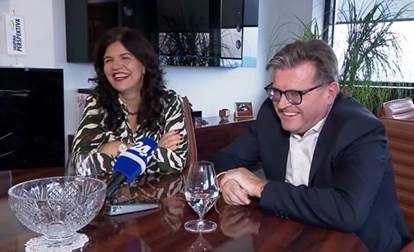
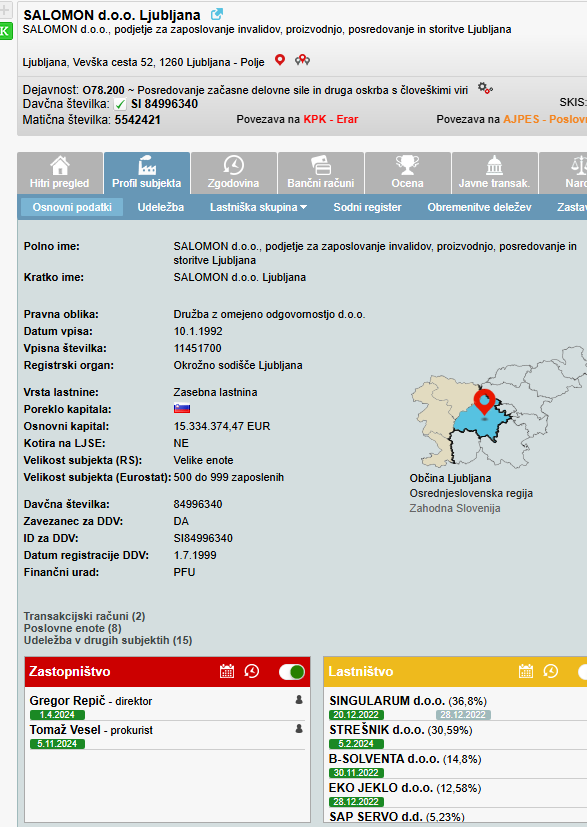
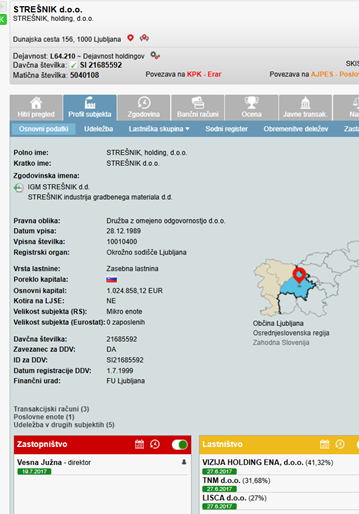
They do not raise the key question: how could tens of thousands of cubic meters of unprocessed construction waste have disappeared and why is no one being held accountable for this? The couple has a significant stake in the largest media conglomerate in the country. Through the company Strešnik, d. o. o., they own more than 30% of Salomon, which brings together print media (including the major ones: Svet24, Večer, Primorske novice), online portals, local media, several radio stations with a reach of 1 million listeners, and two television stations.
Another company that has been building up its position is Kolektor Stojana Petriča, which controls the most important print media in the country, the daily newspaper Delo. It is also entering into business with the state-owned arms holding company established by the government.
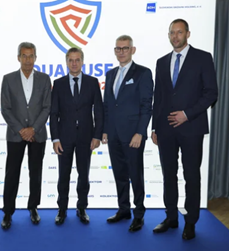
Owner of Kolektor Stojan Petrič and Prime Minister Dr. Robert Golob. (first and second from left to right)
Delo Media, together with the Slovenian State Holding, which is the umbrella manager of state investments, organized a conference entitled The Role of Industry and Critical Infrastructure in Strengthening Civil and State Resilience and announced its entry into the defense industry. Screenshot from the Delo newspaper/Jože Suhadolnik
The media only briefly mentioned the waste story while ceremoniously announcing the opening of the new prison. There were many PR articles, with far more praise for the opening of the prison than those that would write that this is a political and economic conspiracy at the expense of people’s health.
PRISON
The new luxury prison in Dobrunje now covers an area of almost 5 hectares, which is equivalent to seven standard-sized soccer fields. During the excavation of the construction pit for the prison building, more than 38,000 cubic meters of waste was discovered.
The waste from the construction pit contained:
19,800 m³ of soil and stones (non-hazardous waste that was reused),
10,800 m³ of various construction waste (concrete, brick, plastic, iron, steel, wood, bitumen) – in this case, mixed waste that had to be processed and was also partially reused,
3,841 m³ of contaminated soil full of hydrocarbons, PAHs, mineral oils, heavy metals, and tar (hazardous waste). 10% OF HAZARDOUS WASTE FOR PUBLIC HEALTH.

Source: Environmental Impact Report
Decades ago, the prison area was a landfill site, which for many years was filled with construction, household, industrial, medical, and other waste. Documents obtained from the Environmental Agency show that the soil in the construction pit is contaminated with pollutants that are proven to be carcinogenic, mutagenic, and ecotoxic. Due to this alarming discovery, the Environmental Agency initially gave the prison construction project the red light.
Why? Waste had been deposited at a depth of 9-12 meters in the area of today’s prison for decades, but sampling was carried out at a maximum depth of 1.5 meters and only in one case to a depth of 5 meters!

In six months, there was a turnaround, with the Environment Agency softening its opinion and agreeing to the construction. The agency denied that there had been political pressure. In October 2022, the foundation stone for the Dobrunje landfill was laid. The entire political leadership posed for photographers.
Ljubljana Mayor Zoran Janković, former Minister of Justice Dominika Švarc Pipan, who soon resigned, Director General of the Administration for the Enforcement of Criminal Sanctions (URSIKS) Bojan Majcen/ GOV.SI With the new year, 388 prisoners are expected to move in, which will solve the long-standing space constraints of the existing prison in Ljubljana, which is only three meters wide.

With the new year, 388 prisoners are expected to move in, which will solve the long-standing space constraints of the existing prison in Ljubljana, just three months before the elections. This will be one of the major successes of the current government, which has a poor public image due to its inefficiency and the proceedings against the Prime Minister before the Anti-Corruption Commission and the Public Prosecutor’s Office.
The rest is invisible waste, hidden under green embankments and media silence. It has not disappeared.
PUBLIC INTEREST: WASTE REMOVAL AND RESPONSIBILITY OF THOSE INVOLVED
“The prosecutor’s office confirms receipt of a criminal complaint related to the handling of construction waste. However, due to the interests of the pre-trial proceedings and the protection of personal data, we cannot provide any further information,” replied the District State Prosecutor’s Office in Ljubljana. The police questioned transporter Anton Grandovec in connection with environmental crime, but that is all. The environmental inspectorate has also filed several charges for document forgery. The proceedings have been going on for almost a year, but have not yet borne fruit.
The public expects more: the disclosure of those involved, the removal of waste, and the establishment of responsibility where it has been systematically circumvented. Instead of the high standards of transparency promised by the current government when it was elected, mechanisms of concealment have come to the fore, allowing environmental crime to go unchecked for two years.
Dumping soil and construction materials into nature is not a harmless mistake or misdemeanor. It is an environmental crime. The destruction of biodiversity in nature is one of the most serious forms of environmental degradation, which the law treats as seriously as industrial pollution. According to the Criminal Code (Article 332, KZ-1), any action that endangers human health or nature through waste or emissions is punishable by a fine and imprisonment of up to 12 years.
WASTE IS BUSINESS, AND SLOVENIA IS PART OF THE BALKAN ROUTE
While uncovering waste from the Dobrunje prison, we received a lot of information about waste that is illegally dumped throughout the country, not just in the Dobrunje prison area. There is a large landfill near Logatec. The caving association told us that every third karst cave is full of rubbish. In a special operation in 2022, Europol caught environmental criminals who had transported 1,700 tons of waste from Italy, ending up in Croatia, Hungary, and also here in Divača. The so-called Balkan waste route runs through Slovenia from Western Europe. It is one of the most profitable businesses. In 2020, several thousand jumbo bags of ground rubber remained in Slovenia, which, according to media reports, came to the country from Italy and were intended for Serbia.
The investigation revealed that illegal dumping in nature is not just a Slovenian problem. Illegal routes for various types of waste exist throughout Europe. The international project The Illegal Paths of Waste reveals cases where construction waste is illegally dumped in European Union countries. Cases from the United Kingdom, Germany, and France confirm that construction, industrial, and municipal waste often ends up in nature without prior treatment. Such materials often contain toxins, heavy metals, and other hazardous substances that threaten groundwater, ecosystems, and human health. Everywhere, the common denominator is similar to that in Slovenia: ineffective control by local authorities and inspectors, and organized networks that exploit loopholes in the system.
EPILOGUE
Due to the media silence and the issuance of an operating permit despite the falsified and forged documentation, which those responsible did not prevent, the largest environmental non-governmental organization, Rovo, with its numerous lawyers, is drafting a proposal for the temporary suspension of the operating permit for the Dobrunje prison until the irregularities are rectified. Tomaž Grubelnik, a father of three who found an ecological time bomb instead of an idyll in Kukmaki, will file a lawsuit together with his fellow residents for the right to a clean and healthy environment, which has been violated.
We identified the violations on Preiskovalno.si using open-source data, historical satellite images, Google Maps tools, the Land Registry archive, and E-prostor. This case involved a deliberate waste management system involving several actors from the business, political, and media spheres. The government was aware of the violations, but due to the pompous opening of the prison three months before the elections, it did everything it could to silence us. Even though all the relevant institutions in the country confirmed our findings.
To date, no one has ordered the excavation of hazardous waste in the immediate vicinity of settlements. Protecting people’s health is the first and most important public interest of journalism. The silence over the poisoned soil hurts because it is not just ignorance. It is a choice.


